


Every founder I’ve ever interviewed for Millennial Masters swears by their calendar, their endless to-do lists, and the odd sticky note stuck somewhere.
It’s about staying organised in a way that holds up in real life.
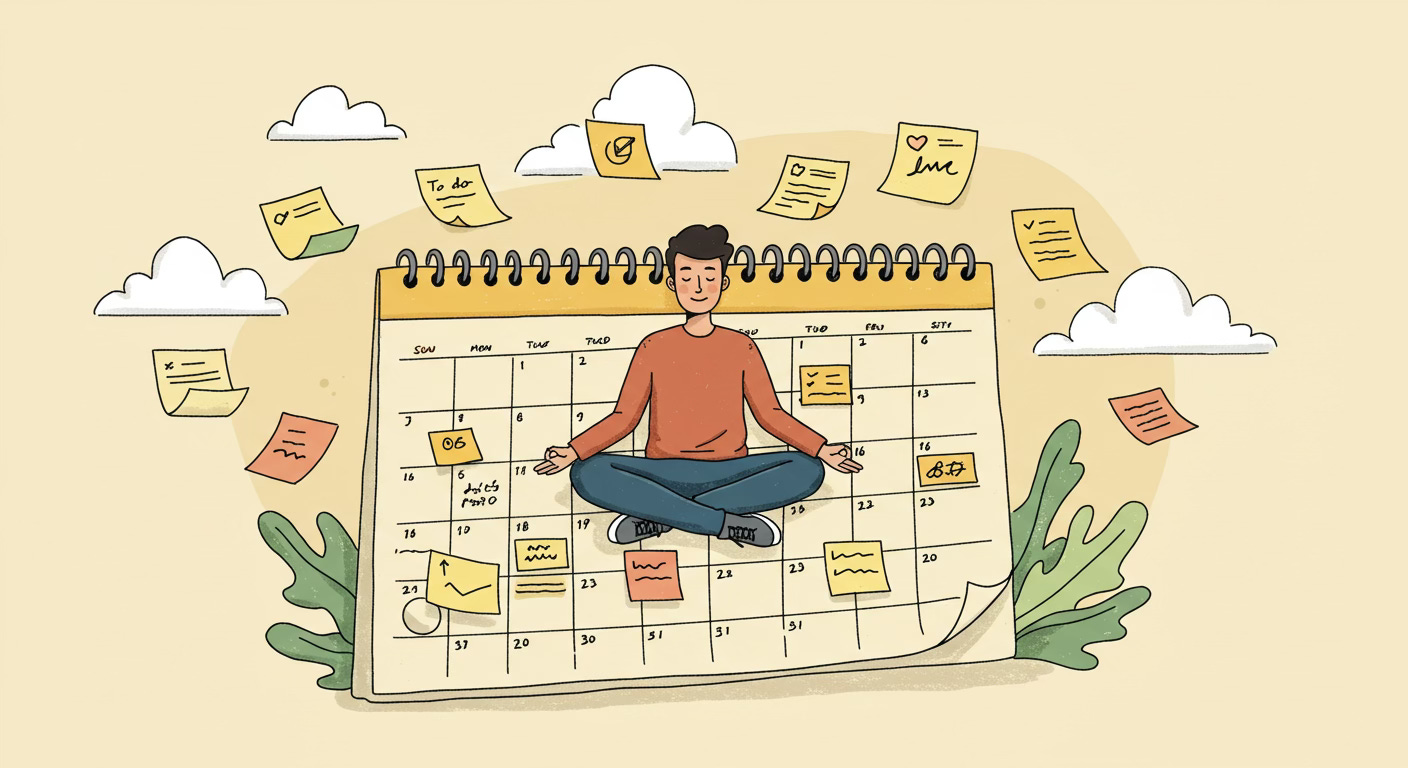
For many, the calendar is the starting point: a living record of meetings, workouts, kids’ birthdays, and even a hard-won hour of nothing.
Some block out family time like a board meeting. Some put gym time right next to investor calls.
Here are the best real-world routines and habits from founders who live by the calendar. 👇🏻
The diary that runs the week
1️⃣ Put everything in your diary, even the boring stuff
“If it’s not in my calendar, it doesn’t get done. My week starts on a Sunday, I sit down and go through everything that I need to do that week. And I stick it in my calendar and I make sure it’s in (colour) blocks.
“If somebody needs a meeting, they can see it's a certain colour code and they know that it's a task that I could potentially move.” – William Stokes (Co-Space)
“My diary is the first thing I look at in the morning and the last thing I look at night to make sure I know what I’m doing in the morning.” – Harvey Armstrong (Prime Time)
If it matters, it goes in the diary. That’s how founders protect their time and their headspace.
2️⃣ Let the calendar hold the tasks
“I use my calendar as a to-do list. Everything is blocked out in my calendar for what I’m doing, the time I’m doing it.
“Even at weekends, if I’ve got to return something to Zara, it’s in there for the hour that I’m going to go and do it.” – Jordan Stachini (Co & Co)
Turning your calendar into your action plan helps stop things slipping.
3️⃣ Block downtime and protect it
“You can put time in your diary, as sad as that sounds, for family time. Because you can have more quality family time when it’s not just dribs and drabs. You say, right, the full day on a Saturday is this.” – Francesca McClory (FutureCloud Accounting)
Scheduling downtime and family time is how many founders protect it. If it isn’t blocked out, it often disappears.
4️⃣ Hard stops and boundaries (yes, really)
“To find the balance, for me personally, I put a lot of hard stops in place. So every night I put my phone on charge in a different room at 7.30pm.” – Amy Morris (Pop Up Global)
“I realised it’s OK to block off free time in the calendar as well, to set up three hours of nothingness, no calls, no nothing. I’m gonna be present and still and with my family.” – Tyler Dunagin (Turnserv)
Boundaries take building. Remove distractions and protect downtime as if it’s a meeting.
5️⃣ Time block for deep work (and protect it)
“My deep work is in the morning and my meetings are generally in the afternoon where I don’t need to be as focused on my mind.” – William Stokes (Co-Space)
“I use the first hour to two for focused work. So there’s usually no meetings before 10am.” – Stefan Husanu (Pith & Stem)
Protecting your best hours for deep work helps you make progress. Block it and defend it, then fit meetings around it.
6️⃣ Prioritise, then delegate without mercy
“I’m always trying to think where can I add the most value and what are the most crucial things? What’s essential Monday, Tuesday, Wednesday, and what is a nice to have? And then I try to not do the nice to haves.” – Jack Good (Reuseabox)
“I literally have a t-shirt that hangs up in my office that says ‘It needs to be done, but I don’t need to do it,’ as a reminder of to delegate essentially.” – Will Polston (North Star Thinking)
The to-do list needs taming. Put your highest-value tasks into prime slots. Everything else gets delegated or parked.
7️⃣ Use tools to cut admin
“The first thing I do in the morning is update my to-do list, figure out what I’m going to do during the day.
“I pause my emails. I have Boomerang for Gmail, which enables you to pause emails coming into your inbox [in certain time windows].” – Michael Buckworth (Buckworths)
“I use WisprFlow and I hit my FN key to speak into my laptop and fill out any form, email, a WhatsApp message. I prefer to orate.
“I’m a Notion guy. I use Notion Clipper to store information and log. I call it logging your knowledge base.” – Oliver Yonchev (cocreatd)
“I use the ChatGPT desktop app and TypingMind for personal productivity, the latter allowing context-specific ‘meta prompts’ for projects.” – Thibault Louis-Lucas
Some founders use tools to cut admin, talk instead of type, and stop email running the day. You should try it too.
8️⃣ Track energy as well as time
“I wear a Whoop band and that’s really insightful. Seeing your sleep in that detail makes you really think about routine.” – Liam White (Dr. Will's)
“What I track every day is a subjective score for how well I felt I slept.” – Archie Mackintosh (TruProductive)
“I do a lot of reflection. I do a lot of journaling and I really think a lot about things. I meditate every day. I journal every day without fail. Get up early to do that because self-reflection is key.” – Gemma Price (HubGem)
Energy is the real currency. Founders who check in with themselves catch problems early before they hit a wall. The most consistent people stay honest with themselves and their calendar.
9️⃣ Block movement and rest into your week
“I go to the gym, I go for a nice long walk, I listen to a podcast, I go for a walk at 8am every day with my husband without fail and so I really prioritise those hours in my day.” – Amy Morris (Pop Up Global)
“Every morning I go for a walk without fail pretty much, normally about an hour. I literally roll out of bed, put a hoodie on and go for a walk. I don’t look at my phone during that walk.” – Nick Telson-Sillett (Trumpet)
If you’re always on, the week catches up with you. Many productive founders keep recurring slots for movement and recovery.
🔟 Write it down and get it out of your head
“You’ve got to write it down, get it out of your head, into your to-do list or into ClickUp or Asana or whatever tool you want to use, Monday or whatever. And then it’s not in your brain anymore and you can focus.” – Kieran Jones (Freethought Group)
“I have a reMarkable digital notepad. I make notes religiously for stuff. If not, then I’m using the notes on the phone. Every time I’m making notes, if there’s an action of something that needs to be done, I do a collation of my tasks.” – Tom Wallace-Smith (Astral Systems)
Whether it’s digital or on paper, founders swear by getting tasks out of their head and onto a list. It creates headspace and helps you move.
Every win starts with a calendar entry
There’s no one-size-fits-all productivity routine. A clear pattern still shows up: treat your calendar like sacred territory.
These founders block out the big things, including deep work and family time.
The to-do list is their ammunition, and if it’s not scheduled, it probably won’t happen.
If you want your week to run better, start blocking time properly.
If your calendar looks too empty, your week probably isn’t planned the way you think it is.
What’s getting blocked this week?


For me, the real lesson when putting together this feature was to add my personal time in my calendar too, every day. I’ve already been living by my calendar, and adding tasks in it too, but blocking personal time in the diary is literally a life changer.
Love the framework. I live through my work calendar, but it's easy to get caught in the minutia. The hardest part is learning to say "no" to things.