


You can spend a long time convincing yourself the product is the work.
It’s easier to stay in building mode because the product gives you something controllable to hold, while sales and demand feel messier and expose you faster.
You tell yourself that if you create something good enough and keep improving it, the right people will eventually notice.
Joshua Dziabiak built a billion-dollar business and said the quiet part plainly: “you could build the best product in the world. And if you don’t have a good strategy to tell the world about it, it doesn’t really matter.”
A lot of early-stage frustration gets explained as a product problem. Joshua wasn’t the first founder to say this to me. He was just one of the clearest.
Across more than 70 Millennial Masters interviews, this has become one of the lessons I keep hearing in different forms: the product can be strong and still lose if the market never understands why it matters. 👇🏻
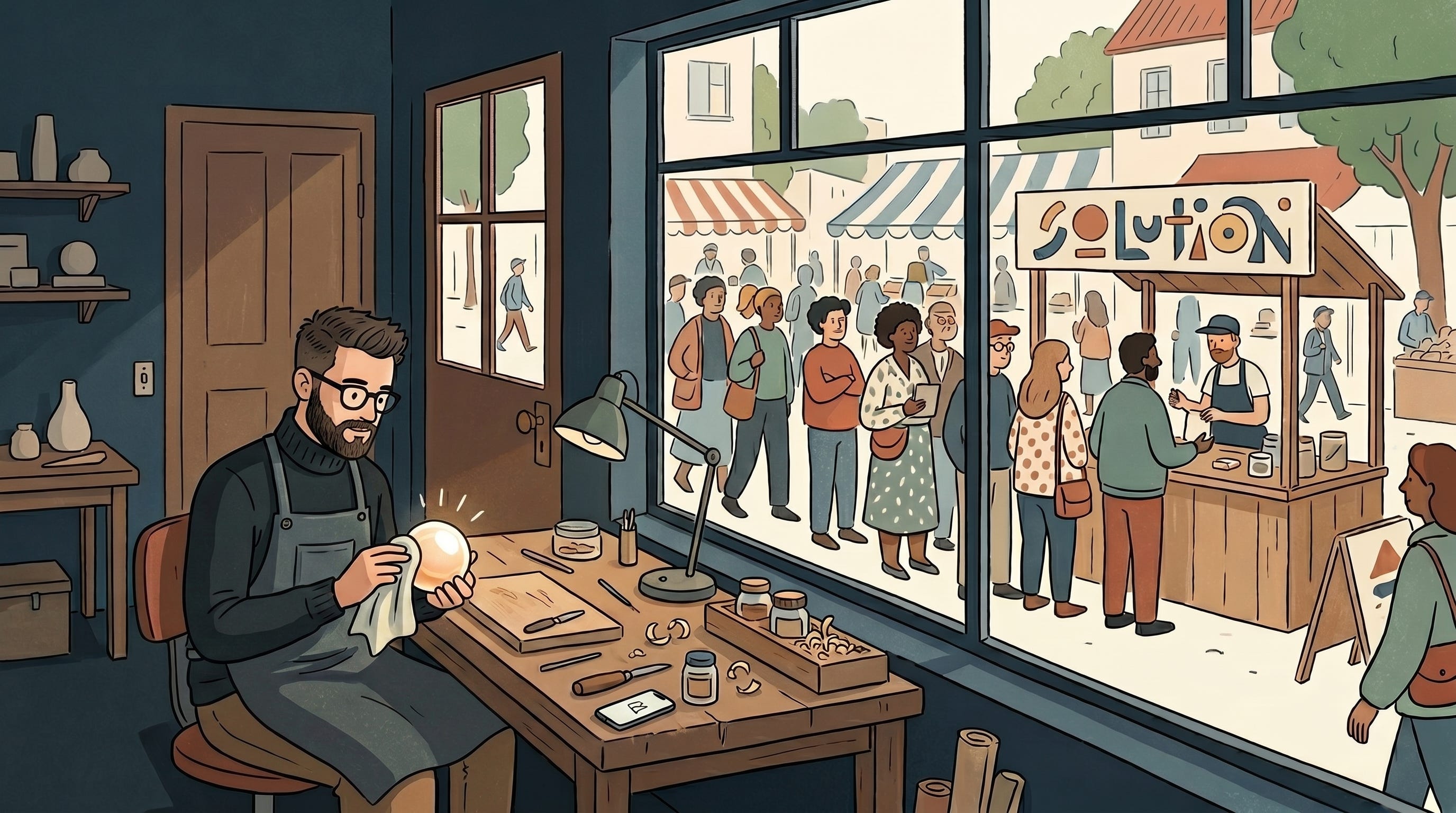
Good products still need demand
The product can be good and solve something real. That still doesn’t make it a business.
Mike Jones learned that too. “When we start our businesses, especially when we’re naive,” he said, you think “as long as we just build a good thing, that it will sell itself because there’s need for it, and there’s demand for it, and it will just work.”
Need can exist, people can show interest, and the business can still fail to move because need on its own is not a sales engine.
You can confuse product quality with traction for longer than you think.
Every improvement gives you another reason to delay the harder question: does the market understand the pain well enough to care?
This question is less comfortable than another feature release. It’s also much closer to the business.
AI changed what’s scarce
AI has lowered the cost of getting something functional into the world, and more people can turn an idea into something usable.
“Imagine if you don’t need developers at all to create products. Where’s the value then if it’s not in the product itself?” For Thibault Louis-Lucas, the answer is distribution and the ability to tell the story around the product.
Simon Jenner put numbers on the table. A product that once cost around £100,000 to build could fall to £10,000 or £15,000 with no-code, and in some cases closer to £3,000 or £4,000 with AI-assisted coding.
Building gets cheaper. The mistake is thinking the business does too. Simon’s warning is that if you spend £10,000 on the product, you’ll still need £10,000 or £20,000 to get it into the market.
Matt Watson saw the same trap from the builder side. A lot of startup founders “like to build things” and “don’t like to sell things.” “You can build anything, but you’ve got to know how to sell it.”
AI makes product quality harder to defend as the only reason someone should pay attention.
Building feels safer than selling
Building protects you from the parts of the job that feel more exposed. Selling means asking, and marketing means explaining yourself before everyone understands.
“Making your dreams come true is embarrassing,” Lauren Currie said. “It’s uncomfortable, it’s sweaty, ugly, you pitch bad, you cry in toilets, you post things that make you cringe later.”
Visibility is “showing yourself and your work to the world before you’re ready.”
Matt saw the same problem with builders spending months with AI tools, writing huge amounts of code without revenue, customers, or proof that anyone wants the thing.
“Claude Code was the needle and every prompt is the drug,” he said. Building gives you momentum you can feel. Selling gives you feedback you might not like.
You can keep calling it product refinement long after it has become avoidance.
Meanwhile, someone with a weaker product gets the market’s attention because they’re willing to explain the problem better.
Lauren also called out “the lie that good work speaks for itself.” Nobody’s coming to find you and tell you it’s finally time to take up space.
The pain has to be clear first
Distribution starts with understanding what people need to hear before they can buy. Traffic and posting matter later.
Melissa Kwan ran into this with eWebinar. People weren’t ready to hear the benefits because they still didn’t understand the pain.
“I can’t sell benefits if they don’t understand the pain,” she said. “I first have to educate them that they have pain to begin with.”
You’re moving people from not seeing the problem to understanding what the current way is costing them.
Matt asks builders a simple question: “How many customers have you talked to about this?” If the answer is none, “then you don’t even know what to build.”
Those conversations shape the product and tell you what has to be obvious before the thing makes sense.
Melissa’s other lesson matters too. She kept hiring agencies to do the hard work she didn’t want to do because she didn’t know the basics of marketing. She put “the most important revenue generating role” in someone else’s hands.
Polish won’t save a weak offer
A better landing page or a tighter deck won’t help much if the offer is weak or unclear.
Freddie Pullen believes “entrepreneurs that do well have incredible offers. You can have a terrible landing page. If you’ve got a really good offer, you’ll still make sales.”
A good offer makes the problem feel real enough to act on. It gives the buyer a reason to care now. If the offer doesn’t solve an issue, “it’s just not clear enough.”
Matt’s own business, FullScale, built an inbound engine through podcasts, newsletters and LinkedIn while many competitors were still relying on cold outbound. That created relationships and leads, and became part of how the business grew.
The product isn’t the whole job
You don’t need to become an influencer.
The correction is less flattering. You have to stop treating visibility and demand like lower-status work.
AI has made building cheaper and faster, so more products are getting into the market. That makes this harder to hide from.
If nobody understands the pain or trusts the offer, the product doesn’t get a fair shot. If they don’t remember you exist, it disappears completely.
You can still care deeply about the product. Just don’t pretend it’s the whole job.


Attention is quickly becoming the scarcest resource in the world
Good products STILL need demand, I love that reminder