



Are your proposals starting to feel like they’re disappearing into a black hole?
You have the first call, the buyer seems interested. Then the proposal goes in and everything suddenly turns cold.
That’s because buyers and procurement teams are starting to use AI tools to review vendors, flag vague claims and compare options before the next call is booked.
David Roy, who writes Eng Sales for technical founders who have become their own first sales rep, started digging into this after one of his own deals was rejected before the demo.
What he found and shared in this guest post is uncomfortable and worth taking seriously. If AI is helping you write faster, there’s a good chance someone on the other side is using it to filter faster too. 👇🏻
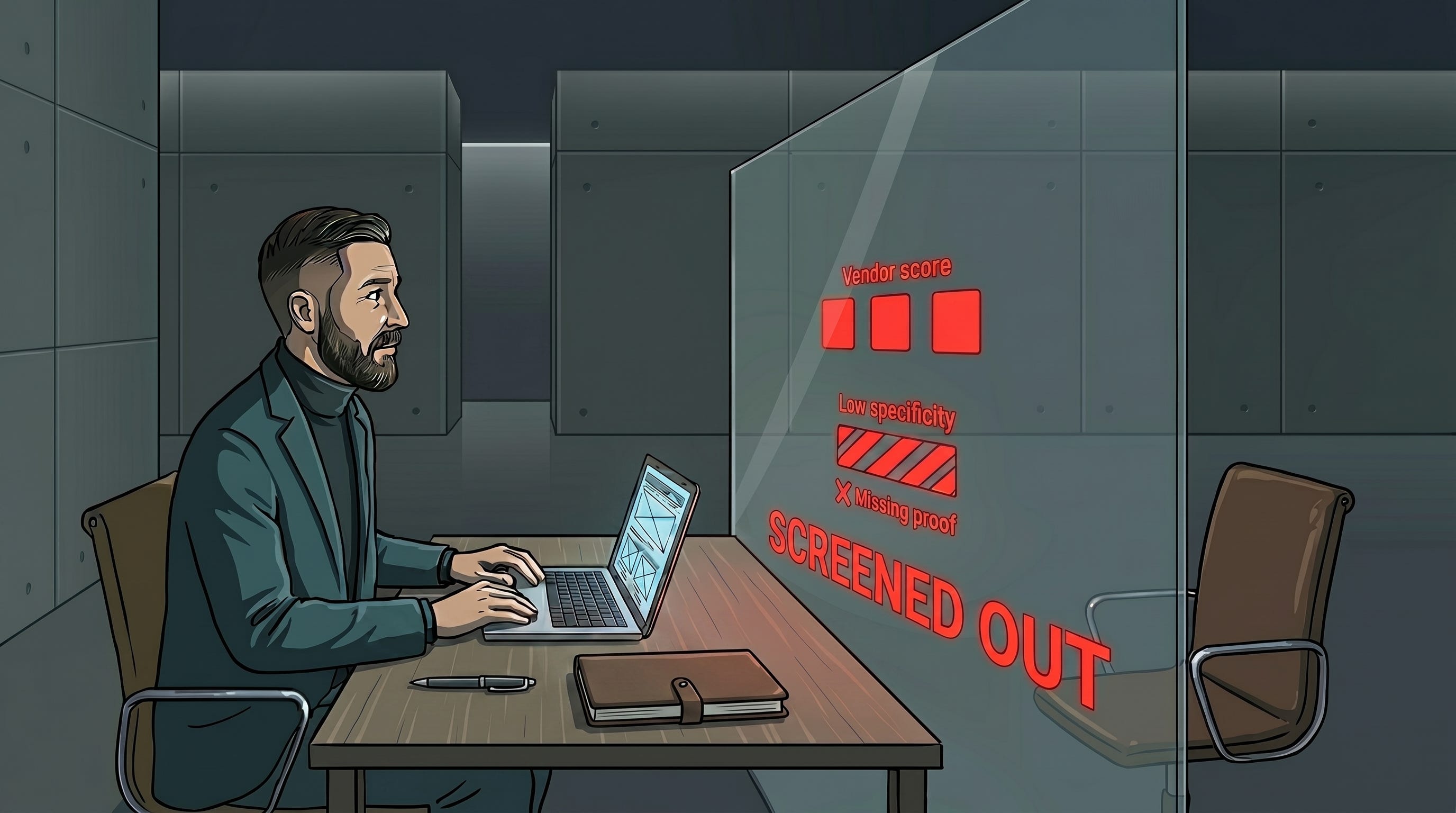
AI judges your business before people do
You trained AI to write your outreach emails, personalise at scale, draft follow-ups and summarise sales calls. Your buyers are training AI to delete them.
Procurement teams are increasingly using AI tools to evaluate vendors before a human gets involved. They’re parsing, scoring and ranking your proposal before anyone on the buying team reads it closely.
Most founders have no idea it’s happening. I didn’t either, until a deal I was certain would close got rejected before the demo.
When I asked why, the procurement lead said: “We flagged your proposal as low-priority. We moved forward with vendors who scored higher.”
That sent me down a rabbit hole. What I found was that “we” wasn’t really a person. In that process, it was an AI screening tool.
If your messaging was built only for human readers, with emotional hooks, narrative flow and relationship cues, it may now be getting filtered before anyone properly reads it.
Figure this out early and you’ll have an advantage, because the buying process is changing quickly.
Here’s what AI tools are starting to filter out, what actually gets through, and how to pass the gate.

The deal died before the demo
The sales conversation used to start when a human read your email or took your call. That window is getting smaller.
Research from Forrester and Gartner shows that B2B buyers often complete a large part of their evaluation before speaking to a vendor. That was already true before AI tools made it easier to sort, score and compare proposals even faster.
In some buying processes, your proposal may now be fed into AI tools before a human review. The buyer can ask whether you match the requirements, where the risks are, and how you compare with the alternatives already under consideration.
That can happen before anyone has properly read what you sent.
The story I mentioned in the intro wasn’t spray-and-pray or cold outreach. We’d already had a strong first conversation. There was a budget, they wanted to improve their sales process, and the sales engineer who was my internal advocate recommended sending an exec summary and key outcomes to procurement.
They were a small manufacturing company with a solid product but inconsistent revenue. I was proposing a fractional revenue officer retainer to help them build a more consistent sales process and support any sales hires they needed.
So I sent what I thought was a solid “exec summary + scope + outcomes” deck. Three months of meetings and prep led to that moment. I’d done similar work for manufacturing companies, in my day job and on the side, and the sales engineer I knew felt good about it too.
Then it went quiet. When procurement finally replied, it was procedural: “Your response didn’t score high enough to move forward.”
I asked the question you don’t usually ask: “Score? Against what?” They answered: “We run all vendor responses through a tool that checks for specificity, missing requirements, and outcome clarity before scheduling any demos.”
I pressed for more details, but was met with: “Sorry, we don’t share the rubric with any vendors at this time.” I was caught off guard because I felt confident I’d at least get to the demo. It was clear the procurement lead was on to the next project, so I followed up with the engineer.
When I grabbed a coffee with her, the first thing she asked was: “Did you ever submit anything?” I told her what I’d put together and shared the response from procurement.
That’s when she told me the “tool” was a new AI agent the procurement team was using to reduce the time it took to review proposals.
That’s when I realised no one had actually read the deck. It got screened first. That made me curious about how common this was becoming.
Through my deep dive, I talked to different procurement leads and business owners. A procurement manager at a mid-market software company told me their team now runs vendor responses through Claude before scheduling calls.
The prompt was direct: “Evaluate this proposal against our requirements doc. Flag any missing mandatory items, vague outcome language, or pricing that doesn’t match our budget range. Score it 1-10 on specificity.” Vendors scoring below 7 were unlikely to get a proper human review.
That matters because AI doesn’t read between the lines. It doesn’t pick up on confidence, credibility signals, or the warmth of your narrative in the same way a human might. It scans for evidence, specificity and measurable outcomes.
If your pitch buries those things, or doesn’t include them at all, it may get filtered before anyone hears your voice.
Why weak proposals get filtered
After that rejection, I started asking questions. This took some time, but that’s why I wanted to share it here.
It turned out the procurement team was using AI to rank every vendor response against a scoring rubric.
I asked what triggered a low score. In my conversations, I noticed four patterns I had missed, and most founders are still missing them too.
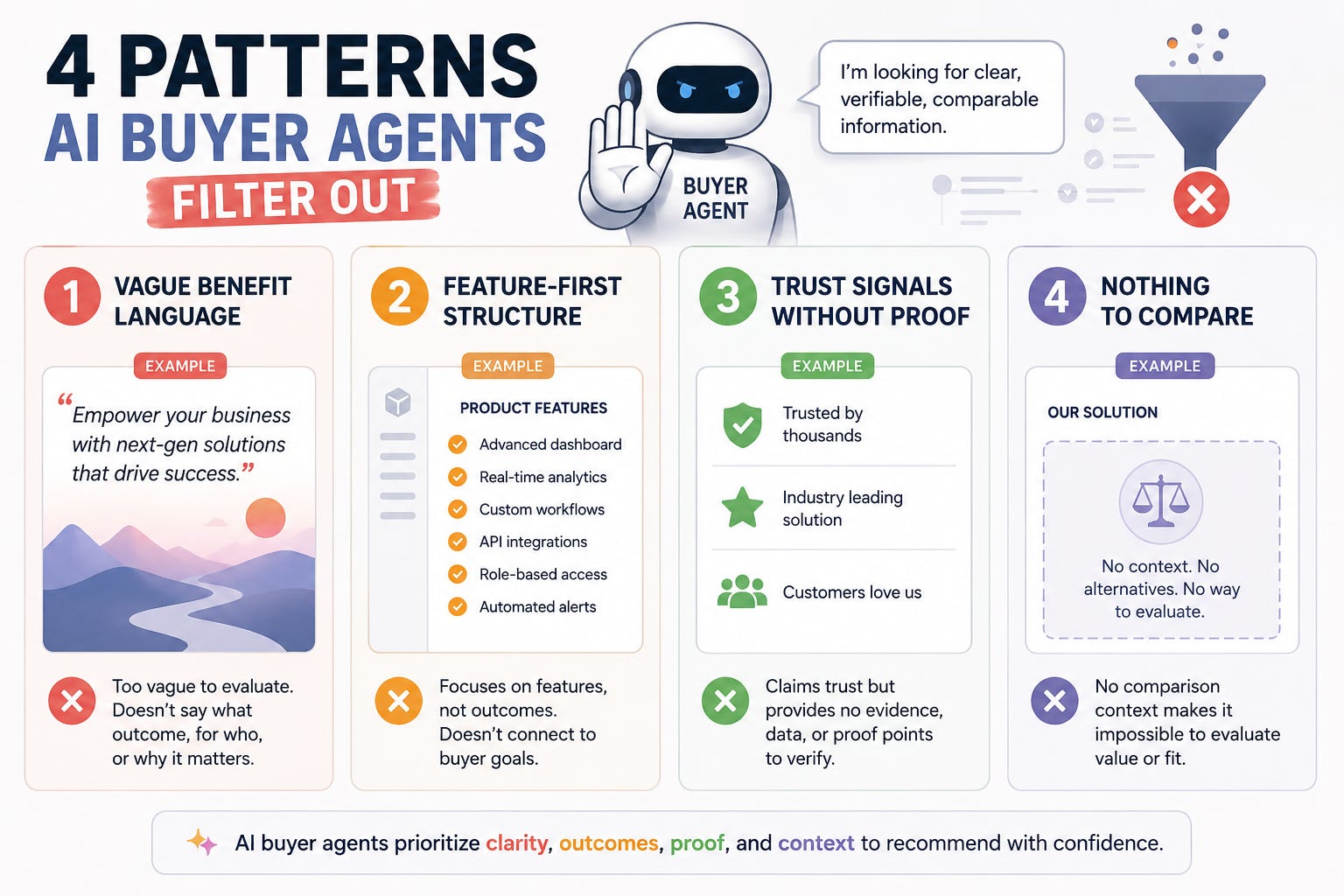
1️⃣ Vague benefit language
Phrases like “we help companies improve efficiency” or “we drive growth” don’t give AI anything useful to evaluate.
They’re adjectives without anchors. AI screening tools can flag language that can’t be quantified and deprioritise vendors using it.
“We help sales teams work smarter” gets filtered.
“We reduce sales cycle time from 90 days to 45 days by fixing discovery call structure” gives the system something to score.
The second one names a problem and an outcome. A few more examples:
Before: “We offer white-glove onboarding.”
After: “We migrate your data in 10 business days, set up three core workflows, and train your team in two 60-minute sessions.”
Before: “Our platform is easy to implement.”
After: “Implementation takes two weeks for a standard rollout, including SSO and one CRM integration. No custom engineering required.”
Before: “We have strong security.”
After: “SOC 2 Type II, SSO, least-privilege access, and audit logs. Security questionnaire turnaround in 48 hours.”
2️⃣ Feature-first structure
Like most founders, I wrote proposals in the order I thought about my product. First, here’s what it is. Then, here’s how it works. Finally, here’s what you get.
Buyer AI is looking for a clearer order. It needs the problem statement, the outcome and the mechanism.
Diagnose their problem first, show that you have delivered similar outcomes, then touch on features. That way the AI and the human get the impact before they stop reading.
3️⃣ Trust signals without proof
“We’ve worked with companies like yours.” Which companies?
“Our clients see significant ROI.” What’s the number?
“We’re a trusted partner in the industry.” According to who?
AI tools are often being used against procurement rubrics that weight evidence over assertion.
If you claim trust without naming a verifiable proof point, you may get flagged as low-credibility. That proof point could be a customer, a metric, or a case study with a clear outcome.
To be fair, procurement teams would have flagged this before AI. The difference now is that weak proof can stop the proposal before anyone sees the rest of it.
Assertion without evidence scores at the bottom.
4️⃣ Nothing to compare
Buyers using AI to evaluate vendors are often generating comparison matrices.
The AI needs something to slot you into. That might be a category, a differentiation point, or a specific problem you solve better than the alternatives.
If your messaging doesn’t give it a hook, you get dropped into a generic bucket and ranked by price. If price is the only differentiator, you’ve already lost.
Hit one of these patterns and you may still survive the screen. Hit two or three and your proposal may never get a proper human read. This felt theoretical at the beginning of the year, but now it’s showing up more often. That means you have to stop writing only for the person you hope will read the proposal and start making the basics clear enough to pass the first screen.
What stronger proposals prove faster
Here’s what changed when I redesigned my proposals for AI-first evaluation. The better versions were structured for machines and written for humans.
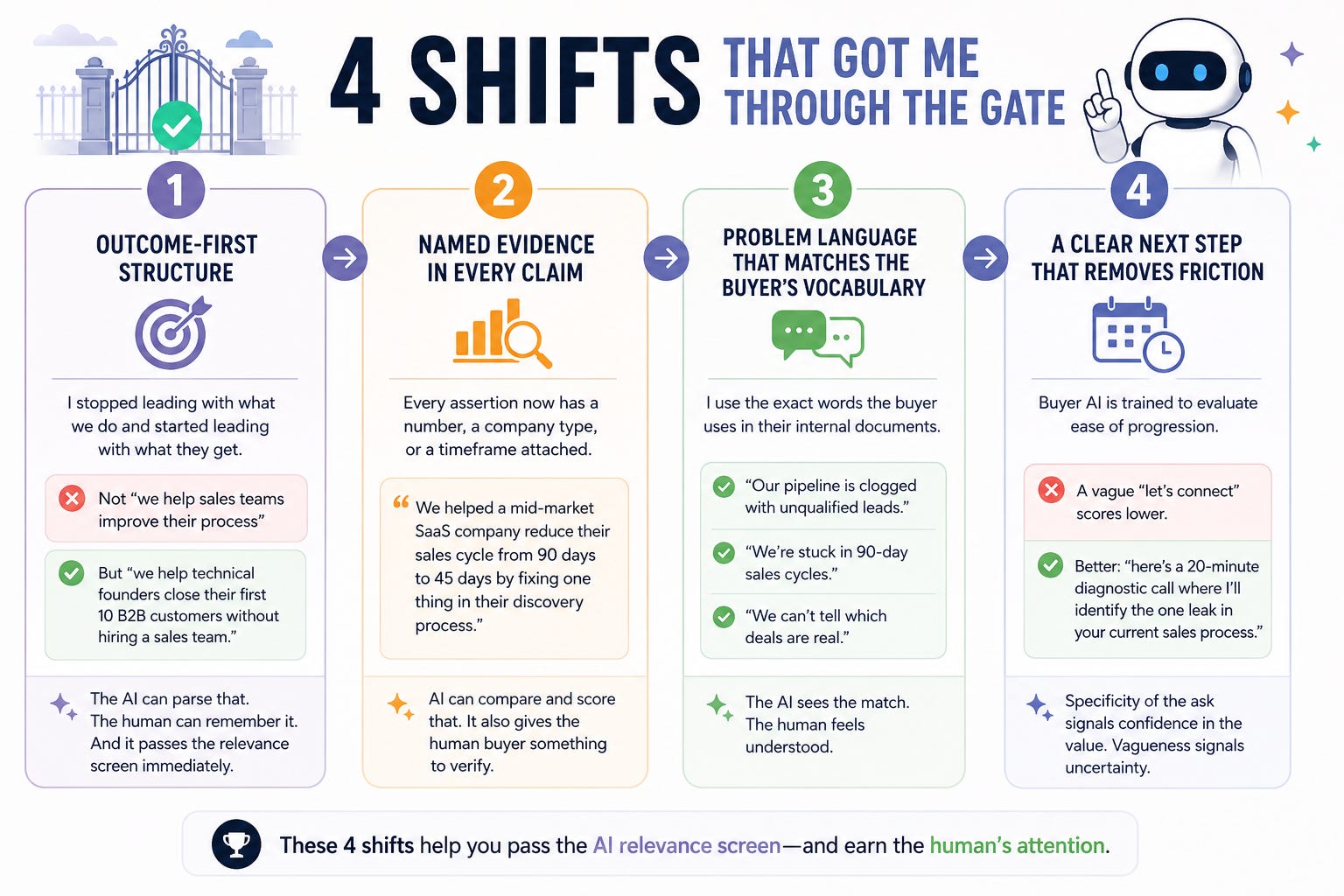
1️⃣ Lead with the outcome
I stopped leading with what we do and started leading with what they get.
Instead of “we help sales teams improve their process”,
I wrote: “We help technical founders close their first 10 B2B customers without hiring a sales team.”
AI can parse that. A human can remember it. It passes the relevance screen much faster.
2️⃣ Attach proof to every claim
Every assertion now has a number, a company type, or a timeframe attached.
“I helped a mid-market HVAC company build their commercial sales cycle to 20% year-on-year growth by fixing their CRM flows.”
AI can compare and score that. It also gives the human buyer something to verify.
3️⃣ Use the buyer’s own words
The best proposals I’ve submitted used the same words the buyer used in their internal documents.
When I’m diagnosing a problem in the first meeting, I write down the exact phrases they use.
“Our pipeline is clogged with unqualified leads.”
“We can’t tell which deals are real.”
Then I use those exact phrases in the proposal.
When your language matches their problem description, you score higher on relevance. The AI sees the match and the human feels understood.
4️⃣ Make the next step clear
I close each proposal with a clear next step.
“Here’s a 20-minute diagnostic call where I’ll identify the one leak in your current sales process.”
The buyer’s AI may be checking ease of progression too. A specific ask signals confidence in the value. A vague next step leaves more work for the buyer.
💡 The rule is simple: if your pitch would be hard for AI to summarise in two sentences, it will be hard for a human to remember after a meeting.
Make it easy to scan for machines and easy to remember for humans.
The 10-minute AI audit
I wanted to make a nice, easy checklist for the Millennial Masters community, pulling these shifts all together.
Here’s your “Pass the Audit” checklist ✅
☑️ Who it’s for (exact persona)
☑️ The measurable outcome
☑️ The mechanism (how you get there)
☑️ One proof point (case/metric/timeframe)
☑️ The next step (time-boxed, low friction)
Before you send your next proposal, run this 10-minute AI audit:
Paste your executive summary into Claude or ChatGPT and ask:
“Summarise this vendor’s offering in two sentences. What problem do they solve and for whom?”
If the AI’s summary doesn’t match what you intended, your message isn’t passing the screen.
Fix it now. Because your buyer may be running a similar test, and you may not get a second chance.


👤 David Roy writes Eng Sales, a weekly newsletter for technical founders who have become their own first sales rep. He writes about sales, pipeline ownership and the revenue systems founders need before they build a bigger team. Connect with David on LinkedIn.


AI is increasingly part of both sides of the sales process, accelerating how proposals are written, reviewed, and filtered before human evaluation even happens.
Teams that adapt their messaging to this reality will likely have a stronger chance of advancing.