



AI has made it much easier to create a mess that looks productive.
Every new tool adds another thing someone has to check and clean up.
Neha Kabra writes The Humanizing and works with banks, fintechs and private equity-backed businesses on making AI work inside complex organisations.
Her piece is about the gap between a good demo and the business strain that follows.
The next discipline is deciding what deserves trust and what should be cut. 👇🏻
AI made building cheap. You can now build and test ideas far faster than you could three years ago. That was supposed to remove the hard part. It mostly moved it.
Uber reportedly burned through its annual Claude Code budget in months. Engineers were ranked on adoption leaderboards. The productivity gains were real, but so was the budget overrun.
That’s the new AI problem in miniature. Creation now scales faster than the business can manage it. The bottleneck moved into judgement and how well the business underneath actually works.
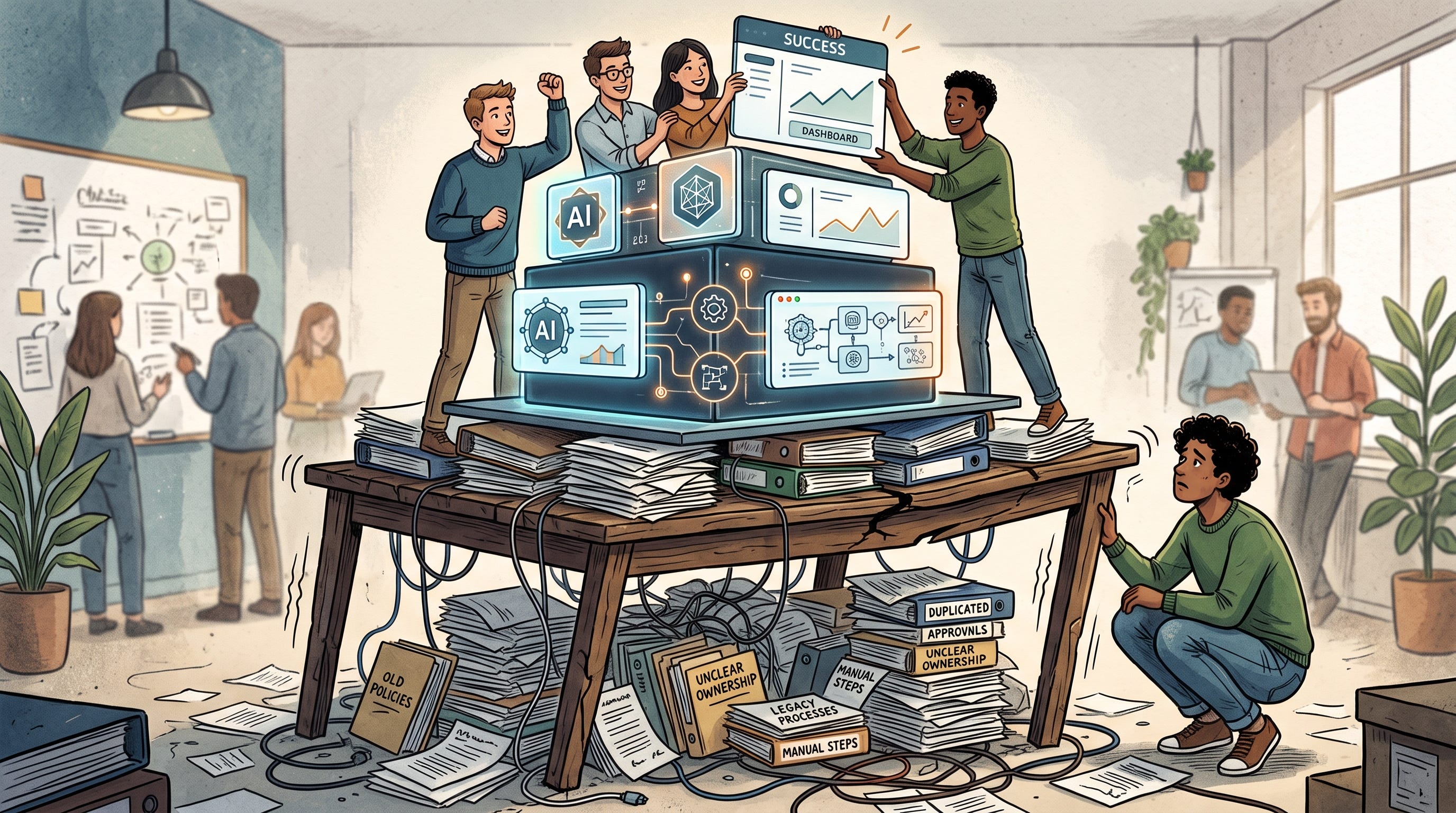
This is where AI slop starts inside a company: tools, dashboards and agents stacked on top of work nobody has properly fixed. It can look productive and still leave someone with more work to check and clean up.
New here? Millennial Masters shares lessons from founders who’ve built and grown companies. Subscribe for ideas on AI, leadership and the decisions that rarely come with a playbook.

Task tools are fragile
A founder building only at the task layer is easy to copy. The kind of tool that writes meeting notes or drafts emails can be absorbed into the base model or bundled into larger tools.
If that’s the whole product, the company is always waiting for the next model update to eat its margin.
Jobs carry a different kind of value. Underwriting or customer servicing depends on judgement and accountability you can’t copy by automating the pieces.
The team that owns the job knows when AI is useful and when it is quietly producing garbage at scale. That judgement is much harder to copy.
Adoption tells you less than trust
Adoption can tell you who clicked. Absorption shows whether the tool has become part of how the work gets done. That means redesigning the workflow and making clear who owns it.
If you’re selling AI into a company, deployment doesn’t prove much. The product has to earn enough trust that people keep using it after the first mistake.
A tool with awkward integration and unclear ownership is easy to replace, especially when the improvement is hard to prove.
AI exposes the mess underneath
Humans know when a policy is out of date, an approval step is ignored or an exception only exists in someone’s head. Agents don’t have that context, so they follow the mess exactly.
When an agent follows a policy that is three years out of date, or routes a decision to a role that no longer exists, the failure is immediate. It can’t politely work around the ambiguity. It reveals the work the business has been avoiding.
The organisational debt was already there. Humans had been quietly working around it, and AI made it much harder to defer.
Every tool becomes a claim on attention
Every AI system you keep creates a weekly claim on someone’s attention. Someone has to check it and decide whether it’s still worth having.
The problem rarely arrives as one big failure. It starts when people stop trusting the tool.
A bank can launch a copilot for relationship managers and see 60% adoption in month one. By month three, usage may collapse because the summaries work for internal meetings and still fail the higher bar of client preparation. The useful question is whether people come back after the first wrong output.
A PE-backed company can deploy a contract review agent and find that 40% of contracts need manual exception handling. The agent only exposed the real problem: the exception process lived in one senior person’s head.
The work required to make AI useful inside a real organisation keeps rising. Twelve AI tools across three teams means twelve things that need checking and justifying every week, whether they’re working or not.
Subtraction is the next advantage
The next advantage belongs to teams that can kill the tools that don’t improve the work.
Subtraction is hard because every tool has people and politics attached to it. Killing one can mean admitting the bet was wrong or accepting that you can’t chase every possible win.
A simple test helps. Remove tools that don’t directly improve a job your customer runs. When two tools do the same thing, keep the one that needs less checking.
If an experiment hasn’t produced a measurable result in ninety days, it’s consuming attention without returning it.
AI made building cheap. AI slop is coming for your business too, unless you can subtract.


👤 Neha Kabra works with banks, fintechs and private equity-backed businesses on making AI work inside complex organisations. Her 18-year career spans banking and consulting, including a decade at McKinsey, and she writes about AI, work and business change at The Humanizing. Connect with Neha on LinkedIn.


Adoption telling you who clicked while absorption shows what people actually trust is a sharp distinction.
It is so easy to mistake velocity for actual progress. Buying a new tool takes five minutes, but fixing a messy, broken workflow takes real effort.
The real skill moving forward isn't adopting every piece of software that drops...it's having the discipline to cut out the noise and keep things simple. Subtraction is highly underrated.