



AI has made it cheaper and faster than ever to build.
That sounds like an advantage until you realise it also makes it easier to waste time and money on the wrong idea.
Barry Winata, partner at MGV Capital and founder of Alpha Bytes, where he writes about startups, investing, technology, and building companies, has seen that from both the operator and the investor side.
In this guest piece, he writes about why founders need better filters now that building is cheap and exploration matters more than ever. 👇🏻
The real skill is choosing what to build
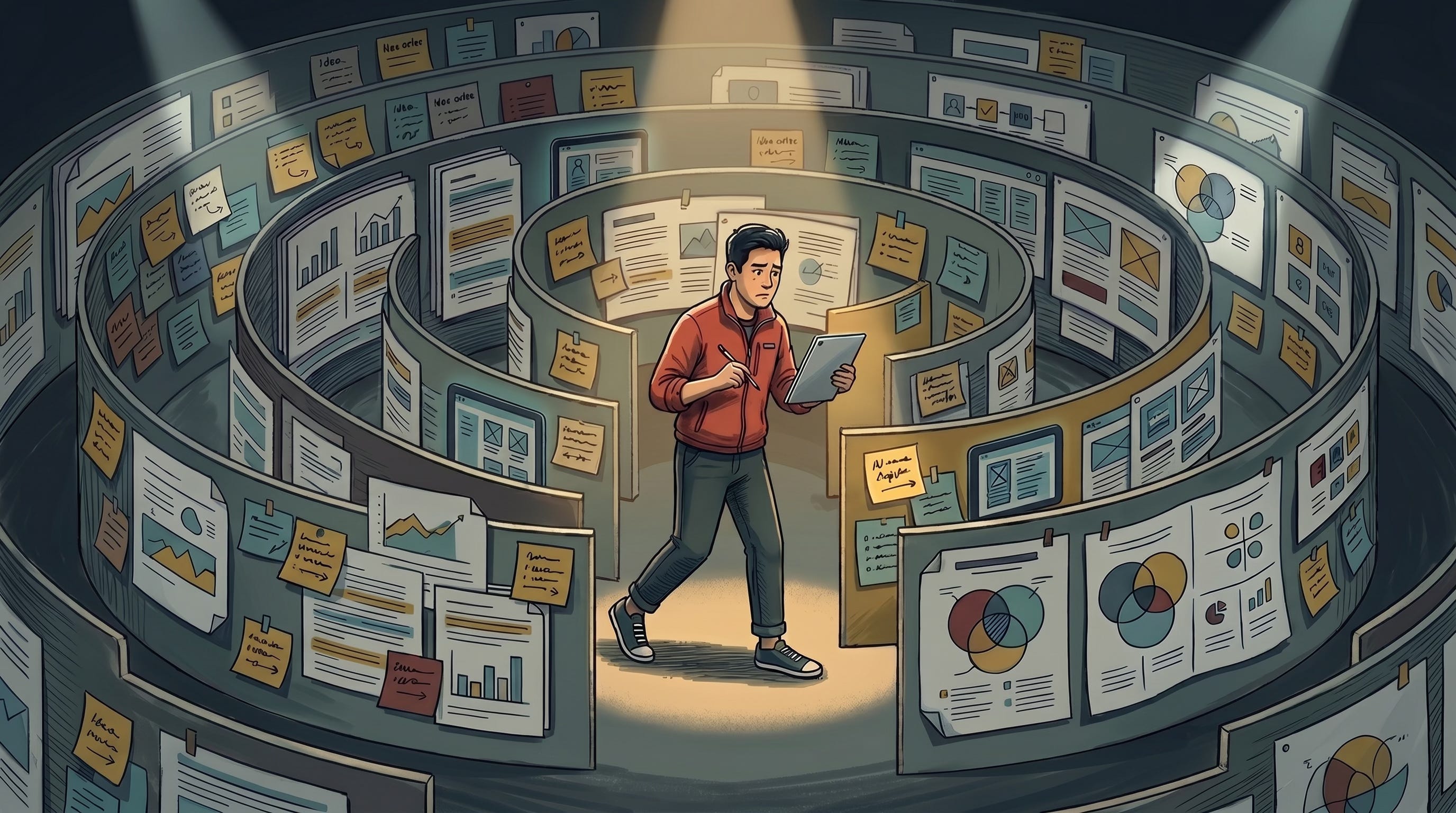
We’re idea machines by nature. That’s never really been an issue.
The problem is that most ideas, even the good ones, aren’t always worth building.
They could be worth exploring. That distinction matters more now than it used to.
The filter is gone
In the old world, scarcity did the filtering for you.
If an idea needed six months and serious capital to prototype, you stress-tested it before writing the first line of code.
You asked hard questions early because the cost of being wrong was enormous. Time, capital, and effort were brutal filters, but honest ones.
That world is disappearing quickly. AI has collapsed the cost of execution in ways that would’ve sounded absurd even a few years ago.
You can spin up an MVP in a weekend and get something usable in front of people almost immediately. The friction that used to kill bad ideas early has gone.
That sounds like progress, and in many ways it is. But it also makes it easier to waste time building the wrong thing.
The bottleneck has changed. It’s no longer “can we build this?” It’s “should we build this, and should we build it now?”
Exploring is not building
After being on both sides of the fence as an entrepreneur and an investor, I’ve noticed there’s a stage between having an idea and shipping it.
That stage is exploration. It’s where you test an idea before putting real resources behind it. No code. No hires. No capital. Just the cheapest due diligence you can do.
The problem is that exploration is messy by nature. Ideas sit in your head, in random notes, in voice memos that make no sense the next morning.
Without structure, exploration becomes a rabbit hole, or it never happens at all because you jump straight into building.
That’s where a system helps. Instead of relying on gut instinct, it gives you a repeatable way to capture, evaluate, and either park or promote ideas.
The goal is to sequence ideas and finding the ones that are actually right for you.
Some ideas are good on paper and still wrong for the person trying to build them because they don’t match their experience, skills, or ambition.
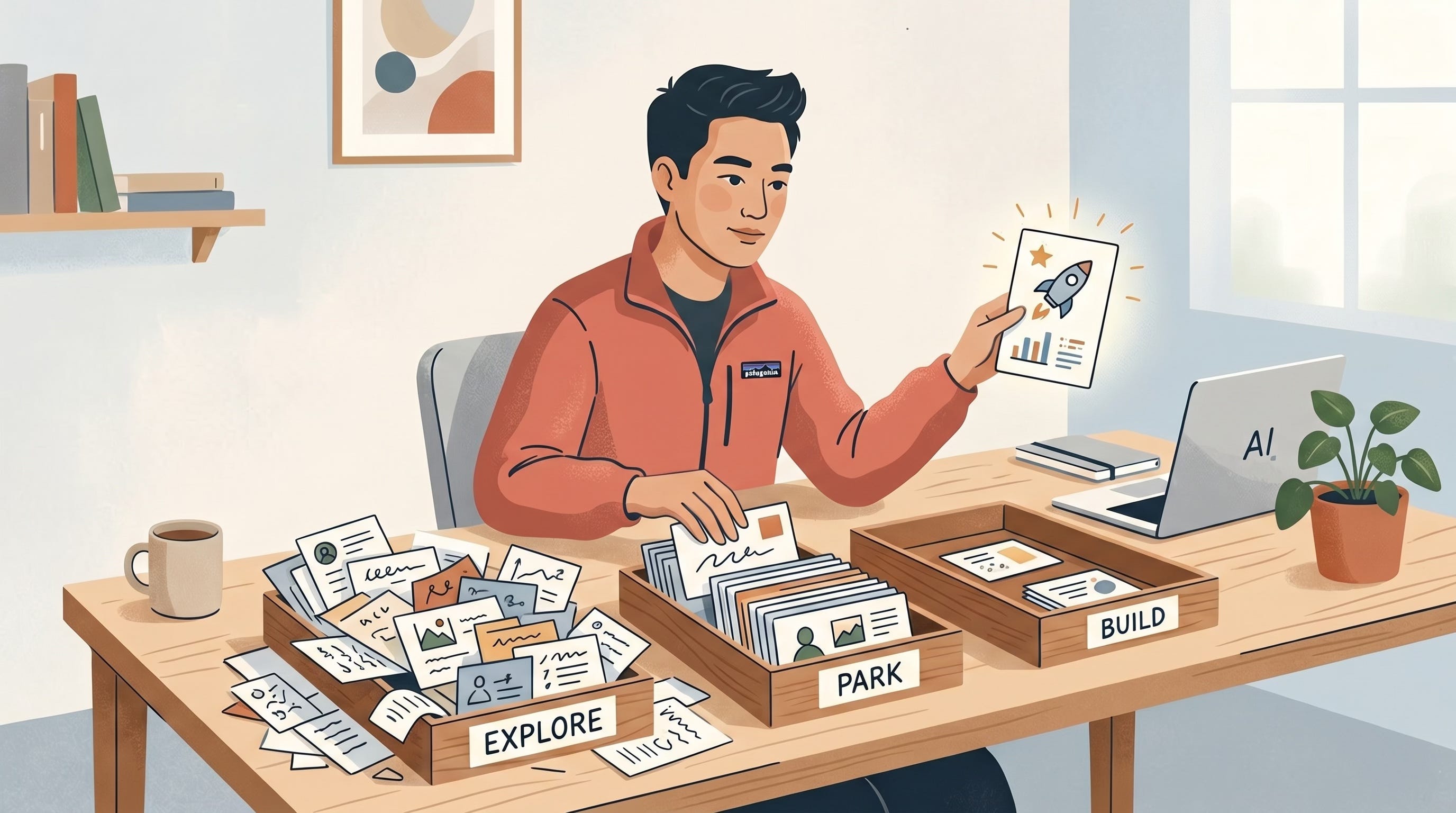
A simple way to do it
I’ve been running a version of this for a while, and it’s changed how I think about new projects. Here’s the framework stripped back to the essentials:
1️⃣ Capture everything. Write every idea down. No filtering. A note, a voice memo, whatever works. The point is to get it out of your head. Unsorted ideas create cognitive load. A log helps with that.
2️⃣ Let it sit. I usually do 72 hours. Some people do 48 hours, some a week. What matters is that you don’t act on it within 24 hours. Excitement is a bad filter. The ideas that still feel interesting after the dopamine fades are the ones worth exploring.
3️⃣ Score, but do not judge. For the ideas that survive, run them through four questions. Does this solve a real problem I can explain in one sentence? Do I have a unique angle or unfair advantage? Is there any sign of demand, even anecdotal? Could I explain this to a stranger in 60 seconds? Anything below your threshold gets parked.
4️⃣ Explore on paper. For ideas that pass the filter, do a focused two- to four-hour research sprint before you build anything. Map the competitive landscape, look at existing solutions, and find communities already talking about the problem. AI can help you synthesise information, but it shouldn’t make the decision for you.
5️⃣ Define the kill criteria. Before you go any further, write down the specific conditions under which you’d stop pursuing the idea. If you can’t articulate what would make you walk away, you’re probably not being honest about the opportunity.
6️⃣ Keep a live repository. The ideas that survive aren’t a to-do list. Revisit them monthly. Look for recurring themes, overlapping audiences, and complementary concepts. Sometimes the best product isn’t a single idea in the log, but the overlap between several of them.
7️⃣ Promote one. Park the rest. When you’re ready to commit real resources, pick one idea and move it into formal validation. Build a landing page, set up interviews, create a waitlist, or talk about it publicly. The rest stay parked.
The trap you need to see coming
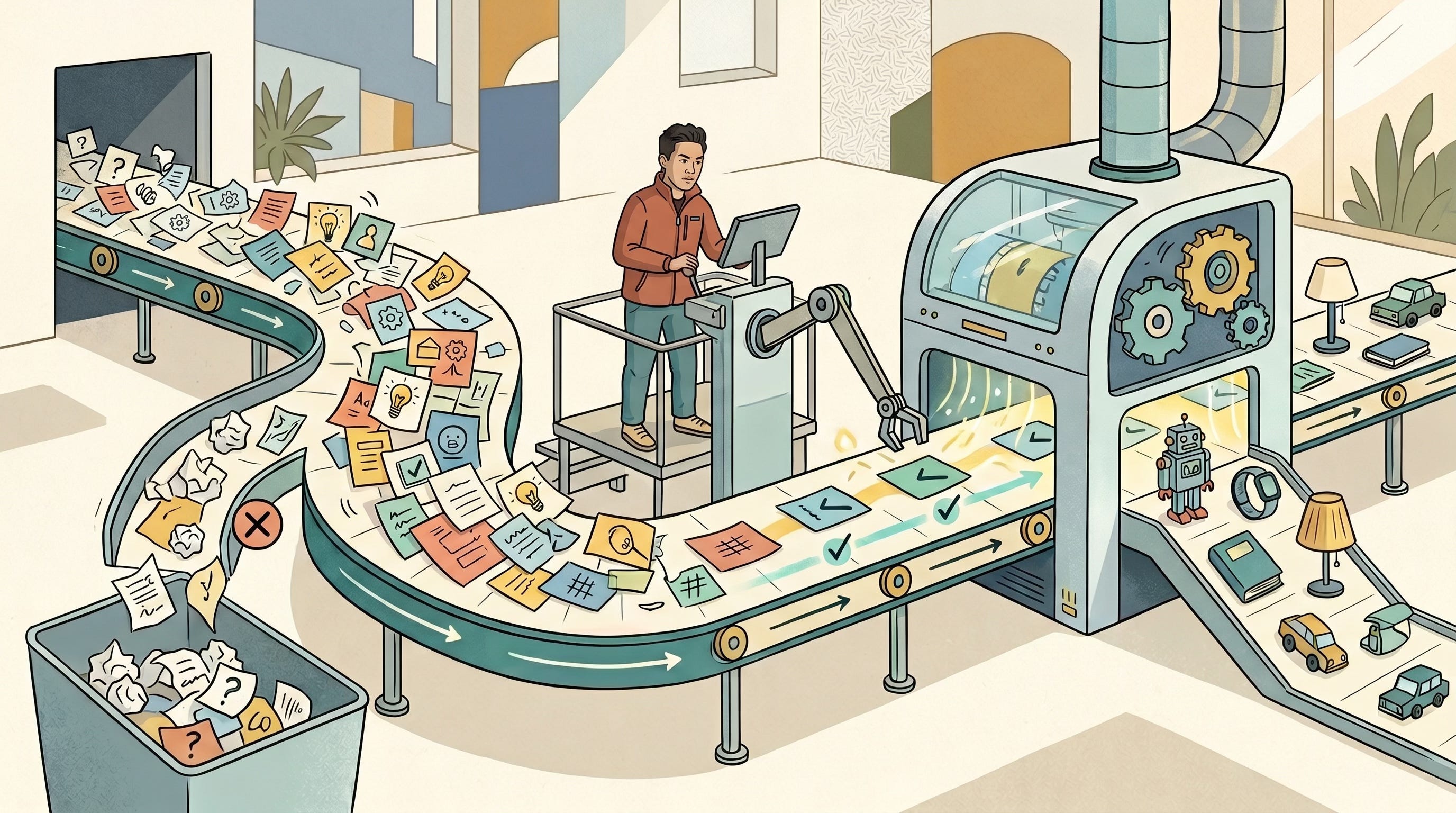
This system has a failure mode, and it’s a seductive one. Too much exploration without commitment is just procrastination.
The system is there to help you decide. If you’ve been exploring the same idea for six months without moving it into validation, that’s probably your answer.
There’s also the temptation to get attached to having a rich idea log without ever acting on it.
The log is there to help you move. To stop it turning into a trophy case, set a cadence, quarterly at minimum, where you force a promote-or-park decision on your top ideas.
AI can make this trap worse. Because it can generate research, competitive analysis, and prototype mockups on demand, it’s easy to confuse activity with progress. A lot of output can still mean very little progress.
The real advantage now
Humans will keep generating ideas. That part isn’t changing.
What’s changed is the cost of acting on them, and with it, the cost of acting on the wrong ones.
In the AI economy, speed alone won’t be enough. The difference is knowing what deserves real commitment and what should stay in exploration.
👤 Barry Winata is a partner at MGV Capital and writes Alpha Bytes. Before moving into investing, he spent nearly a decade as an operator across engineering, growth, recruiting, product, operations, and sales, helping startups grow into successful companies, including businesses acquired by Verizon and others backed by investors such as SoftBank, Intel, and Samsung. Connect with Barry on LinkedIn.



REALLY interesting perspective on the importance of judgement and taste
Great take. Finding your "zone of genius" becoming even more important with these tools to avoid spinning.