


It’s an unfair advantage that only money and experience can buy. I learned this the hard way.
It’s easy to believe you can correct things later, once there’s more money or traction, yet the early choices decide who feels comfortable joining next.
When you’re a first-time founder, especially before a fundraise, you don’t fully see how much this shapes everything that follows.
Bringing in strong early hires is hard when money is tight and your name doesn’t yet carry weight.
The people who change the trajectory of a company tend to arrive through trust and reputation, and both of those are rare early on.
That’s why I asked Cris Cafiero to write this guest post. He advises investor-backed companies through his work with Sequoia, helping leadership teams make clearer decisions about hiring as they grow.
Cris also writes the Startup People Spend newsletter, where he studies how early people decisions compound over time. 👇🏻

Hiring is a network effect
Five AI startups raised $20b+ with a combined valuation of $206b, all led by former Google employees:
Anthropic – Dario Amodei was a senior research scientist at Google Brain
Perplexity – Aravind Srinivas was a research intern at Google
Mistral AI – Arthur Mensch spent three years at Google DeepMind
Cohere – Aidan Gomez was a researcher at Google Brain
Glean – Arvind Jain was an engineer at Google
Welcome to the ‘Google Mafia’. One respected alum starts a company and pulls in former colleagues, who then bring people they already trust. In this case, talent and capital moved together from Google.
I see it in Series A and B companies all the time. Founders raise from people they already know or who trust someone involved early. That backing often brings attention, introductions, and follow-on interest.
The more time I spend around early-stage teams, the clearer it becomes that recruiting success is shaped less by sourcing tactics and more by who shows up first.
Signals
“The first 100 people you hire will define the next 200.” — Molly Graham, ex-Facebook
When I ask founders how many early hires came from their own network, the answer is usually most of them.
They’re friends and former colleagues who didn’t hesitate when you told them you had seed funding, a big idea, and almost nothing built yet.
This is where trust starts. It spreads through referrals.
The strongest signal of how someone will perform is often who brought them in. Good people tend to recommend people like them.
There’s another part to this. Your startup sends signals long before anyone talks to you. People decide whether they want in based on what they see from the outside.
Four signals show up again and again: taste, velocity, capital, and values.
Before you have a brand, these signals do most of the work in hiring and early traction. Teams tend to lean harder on the ones they already have while the rest catch up.
Taste
The quality of your product and design pulls people in, especially those who care about craft. They notice it right away, even if they can’t explain why. It’s just good.
A reputation for good taste shows people what you care about. It comes through in the product, the code, the brand, and the details. People who take pride in their work tend to look for teams that do the same.
A few startups that show this well:
Notion has a product that feels considered from end to end. The design is clear, the experience is calm, and the brand is consistent without trying too hard.
Clay built something that people can pick up quickly and keep growing into. It has a strong point of view, and the visual choices feel deliberate rather than decorative.
Velocity
The buzz of rapid progress is contagious.
When the product and user base are visibly growing, that growth attracts and retains talent and capital.
Founders who show their progress make it clear how the company operates day to day. That clarity tends to attract builders who care about getting real work shipped.
Startups moving quickly (and publicly):
Ramp are shipping features faster than anyone on the market, and they’re fundraising at breakneck speed, closing a $500m round 45 days after their previous.
Perplexity AI is focused on rapid iteration and user-focused launches, posting regular “What We Shipped” posts to their changelog to highlight their pace. Imaginative, hypnotic brand aesthetic too.
Capital
It’s shorthand for credibility.
Funding from the right sources signals to candidates that someone else has already run diligence on you. It reduces personal risk and puts the company on more radars.
A well-known investor (a16z, Sequoia, etc.) or a hefty funding round announcement can pull in people who were not actively looking. It also makes introductions easier, across hiring, customers, and future fundraising.
As Marc Andreessen says: “The thing you want from your venture firm is power.”
Companies grabbing headlines with power raises:
Rillet raised $70m Series B led by a16z and ICONIQ Capital after doubling ARR within just 12 weeks.
Kalshi raised $165M from Paradigm & Sequoia to be the market for predictions & forecasting.
Values
The boundaries you set early shape how the company behaves day to day and what it stands for. It’s a powerful attractor for talent.
Vague slogans do not hold up here (“work hard, play hard” won’t cut it). Early hires need to live these values because people talk. The people who stay tend to share those standards.
Netflix’s “keeper test” is a clear example. It filters for high-performers who don’t tolerate mediocrity or even “brilliant jerks.” Outsiders judge it as intense or even unfair, but insiders love it.
Here are a couple companies with thoughtful, intentional company values:
Zapier has been a remote-first organisation since before it was cool. I love how they tout their values in practice and with examples.
Strava anchors its values in sport and community, which shows up in how it treats both users and employees.
A loop worth protecting
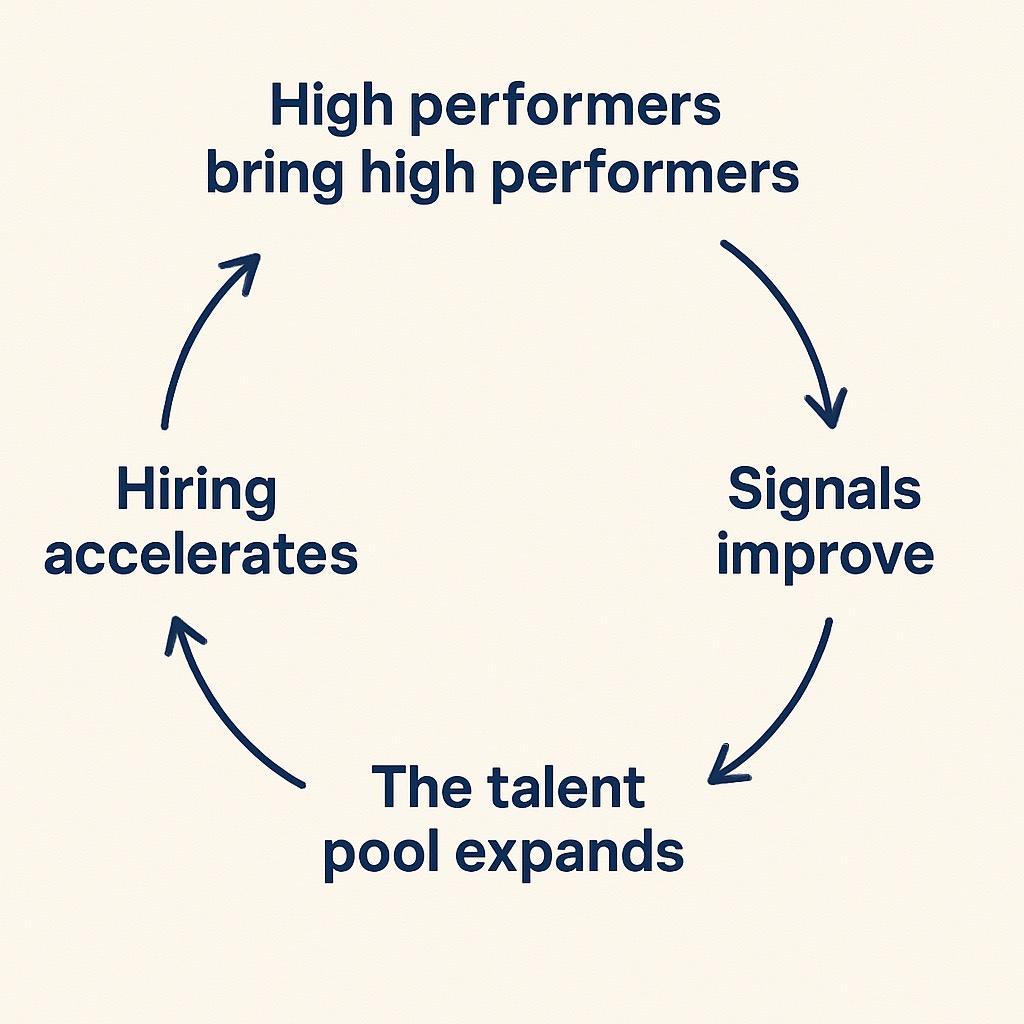
When a respected hire leaves, parts of their network often leave with them.
Future fundraising follows the same pattern. A poor investor choice can limit future funding options.
Protecting the integrity of your network is protecting the future of your team.
If you get it wrong, the loop works against you.
👤 Cris Cafiero works with investor-backed companies at Sequoia, where he helps leadership teams think clearly about hiring, compensation, and people spend as they scale. He also writes the Startup People Spend newsletter.

🤜🤛 More teamwork from Millennial Masters


It’s a reminder that hiring is as strategic as product or fundraising, especially when traction is still nascent.
I like how clearly you frame hiring as a network effect rather than a sourcing problem. That feels far closer to reality than most hiring advice aimed at early founders.