



If you’re buying AI tools because you want the business to move faster, ask a harder question first.
Can the business actually handle more speed?
When everything still runs through a few people, or one very tired founder, AI doesn’t remove the problem. It puts more weight on it.
In this guest piece, Sam Rees, Reg.Psych, founder of Orby and writer of The Adaptive Organization, explains why AI exposes the weak spots the business was already working around. 👇🏻
AI will find the cracks
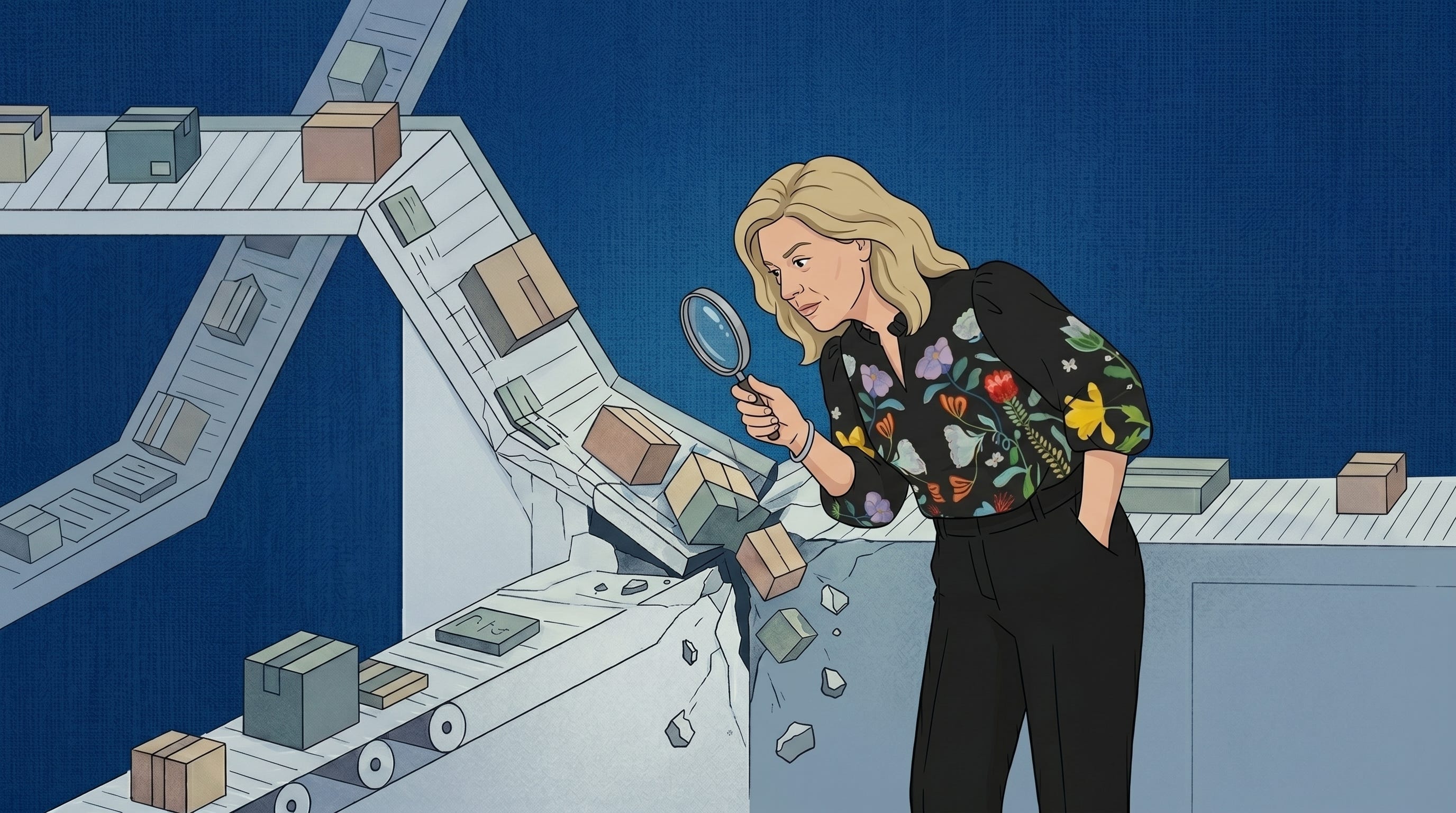
It’s six months since you signed the AI contract. The tool is still being paid for, but no one on your team has opened it in three weeks. You still haven’t decided whether to call it a failure, so for now it stays “in pilot”.
You probably blame the tool, or you blame the people around it. Some of that may be true, but it still misses the bigger problem. The business underneath it was never designed to absorb change quickly.
AI added pressure, and that pressure exposed cracks that were already there. You just hadn’t seen them yet because nothing had pushed hard enough.
AI pushes harder than anything your business had to absorb before.
Most failed AI rollouts get described as tooling failures, whether the tool was a bad fit, the data was poor, or adoption never really happened.
The algorithm is only a small part of whether AI works. More of it sits in the data, the tools already in place, and the way the work actually happens. Most businesses haven’t changed any of that.
That is why AI adoption stalls so often between pilot and production. The tool gets bolted onto the existing process, and the bottleneck stays exactly where it was.
What a fragile business looks like
Fragility sits in the boring parts of the business. It shows up after the contract is signed, when no one can tell you who owns the customer.
It is there in the hiring decision that still needs four people in a room, in the task that gets done three times because ownership is unclear, and in every meaningful decision that routes back through you because you’re still the only person who knows the full picture.
Ownership lives in people’s heads, so when someone leaves, the knowledge and the process go with them. Teams “work it out” every time because no one ever decided what done looks like.
People don’t know what they’re allowed to decide, so they escalate. Senior people end up carrying outcomes they can’t really influence.
You’re still the operating system the business quietly depends on to make things happen.
A business can survive like this when work moves slowly and people are still covering the gaps. It starts to matter when you ask that same system to take on AI.

Why AI makes the cracks visible
You’ve absorbed other changes before, whether that was a hire, a CRM rollout, or a pricing change. You got through them by working harder.
AI is different because it moves work faster than your team can handle cleanly. If your handoffs were already messy, it doesn’t wait for clarity. It generates, and the mess compounds.
It also cuts across teams. Real use cases rarely sit neatly inside one function. They move between sales and ops, product and support, finance and delivery. If those boundaries are unclear, AI magnifies the confusion.
It pushes decisions closer to the edge too. The value of AI sits in routine decisions moving faster than a weekly leadership meeting can authorise.
If your business still runs on one or two people reviewing everything, AI doesn’t solve that. It exposes how expensive that delay really is.
The work gets worse before it gets better
Adoption often looks worse before it gets better because the work in the middle is slow and unglamorous.
You have to clean up the process, decide who owns what, train people properly, and stop pretending the tool will fix the mess on its own. It costs time and money before it looks useful.
Businesses judging AI too quickly often cut the work that would have helped it succeed. The initiative gets written off and the conclusion is that AI is not for them yet.
That’s usually the wrong conclusion. The business just isn’t ready for what it is asking AI to do.
Ask what would break first
If you doubled volume next quarter, what would break first? Whatever breaks first is already fragile. You just haven’t had to face it yet.
AI brings that pressure faster than most teams are ready for. It speeds up the work and leaves less room to stop and fix what is going wrong.
Wherever your answer lands, that is where the work has to start. If the business is still running on you, or on a few people holding everything together, AI will find that quickly.
Better to find out before you’ve signed the contract. Better still to solve it now, before the contract turns the weakness into an expensive lesson.
The businesses using AI well tend to have the basics in place. People know what they own. Decisions happen closer to the work. The founder is no longer the operating system.
Their advantage comes from the structure underneath. The tool you’re about to buy will only ever be as good as the system you put it into.
👤 Sam Rees is a registered psychologist and the founder of Orby, an Organisational Effectiveness System that helps leaders design businesses that can absorb change rather than just react to it. She writes The Adaptive Organization on Substack. Connect with Samantha on LinkedIn.


Interesting (move fast and break things 2.0.)
New innovation. 99.99% are zero competence. It's always the way.