



Raising a serious round feels like the moment the business becomes real.
That feeling is dangerous once the money lands and problems are easier to ignore.
I’ve learned the hard way that funding doesn’t mean the business will survive.
That’s why I invited Ben Botes | GP & 4x Founder to write this guest post. He’s a four-time founder and investor who also writes the ScaleSignals newsletter.
His argument is uncomfortable: the money can hide the problems that still need fixing. 👇🏻
New here? Millennial Masters shares practical lessons from founders on building better companies and handling the parts of the job nobody prepares you for. Subscribe for honest ideas on growth, AI, leadership and the decisions that shape your business.


The cash is hiding the cracks
Nobody wants to say this at the celebration dinner, but a company can raise brilliantly and still struggle afterwards.
I’ve watched it happen from a few angles, first as a four-time founder and later from the investor side of the table. Funding helps, but the raise itself tells you very little about whether the business will work.
It took me a long time to accept that raising well can leave a company in worse shape. I now pay far more attention to what founders do during the 18 months after the money arrives.
Money changes how you behave
A raise changes the pressure inside the company in ways that can hurt you.
When you have very little money, you’re forced to focus on one thing for a clear customer because you can’t afford to chase every opportunity. That pressure keeps the company disciplined.
After the raise, five ideas suddenly look affordable. The company starts spreading itself across them, and every individual decision looks like progress at the time.
The risk begins when the story needed for the next round starts pulling the product away from what current customers use it for.
Investors also become another group whose expectations shape your decisions. The raise commits you to the future performance you sold to them.
Then the raise changes how you feel about the company. After months spent closing the round, it’s easy to feel like you’ve finished something.
But the day the money lands is when the real test begins.
The runway hides more than it fixes
A company that raises a big round can appear to be winning. Press coverage and hiring create visible signs of progress.
For a while, the money papers over problems that would otherwise have killed the company, or at least forced it to fix them.
Runway can hide weak unit economics for longer. Marketing spend can cover unclear positioning while new acquisition replaces the users who keep leaving.
The money postpones the point when the company has to deal with them, which gives those problems more time to grow.
The company that would have been forced to confront its weak retention at $200K in the bank gets to ignore it until it has burned $8M, at which point the same problem is much bigger and much harder to fix, and the runway that was hiding it is gone.
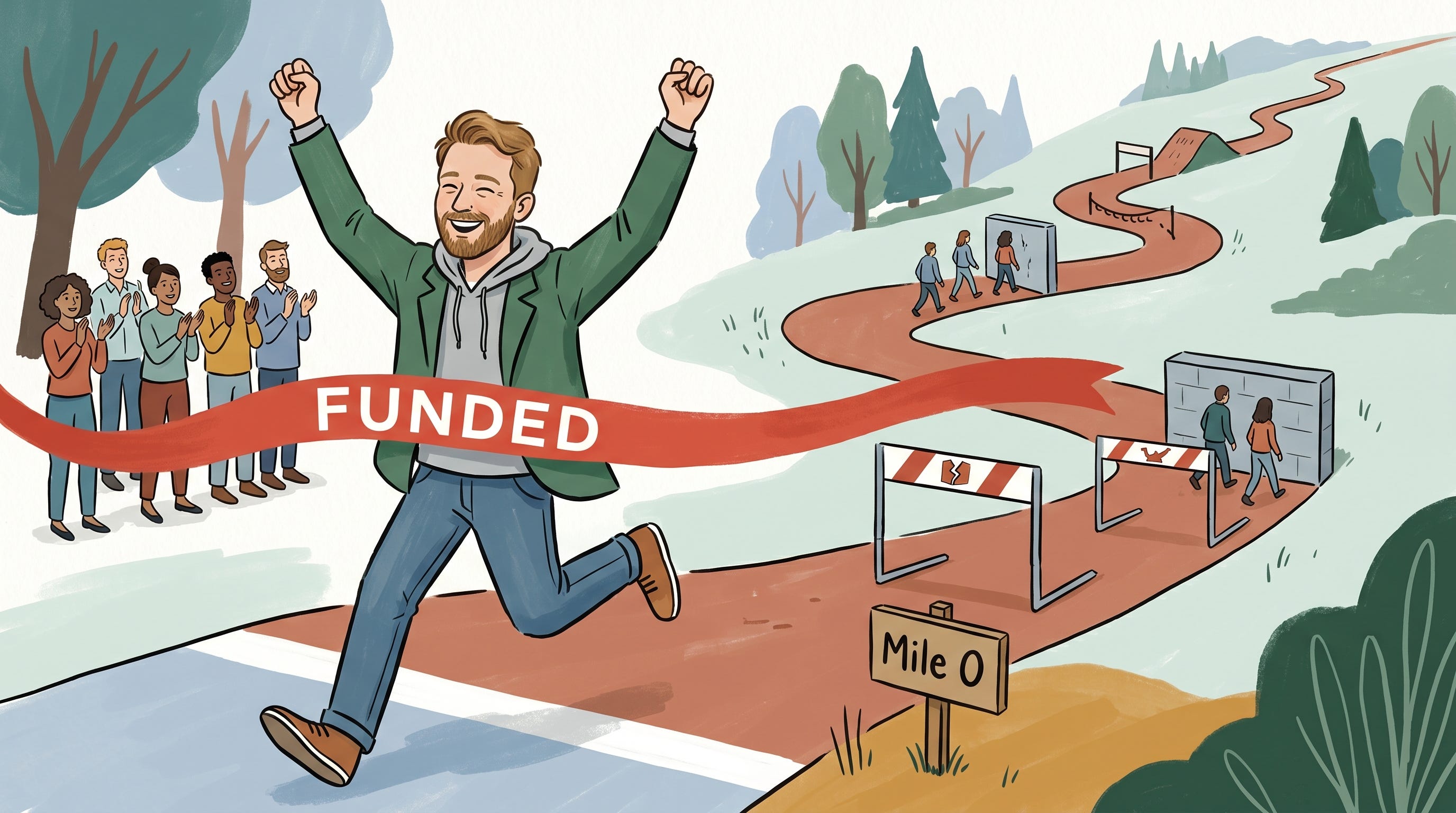
This is why “they raised a huge round” tells you almost nothing about whether a company is healthy. The money can accelerate a business that already works.
On raise day, a strong business and a weak one can look equally healthy because both have cash.
Keep the discipline that got you funded
The founders I’ve watched come through this well all do a version of the same thing. They keep the discipline that scarcity used to force on them.
They keep doing one thing well, even though they can now afford to pursue five. They use the extra runway to deepen what already works and stay honest about what the money may be hiding.
The week after the round closes, disciplined founders look for the issue most likely to hurt the company later and deal with it while they can still afford to.
Customer needs still have to guide the product after the raise. The next round can become so visible that customer signals get pushed aside.
A company that keeps improving for customers gives itself a stronger case when the next round comes.
The round only buys you time
A raise only proves that someone believes the company can work. The business still has to justify the cheque.
The 18 months after the round show whether they were right or whether you simply became very good at raising.
If you’ve just closed a round, celebrate it. Then use the next year and a half to prove the business deserved the money.
👤 Ben Botes is an active GP, 4x exited founder, and the author of Unstoppable Growth. He writes about capital, growth, and what actually happens after the raise at ScaleSignals. Connect with Ben on LinkedIn.



Capital creates time, but it doesn’t create fundamentals. Strong businesses use funding to accelerate, not avoid reality.
A raise can validate momentum, but it can also reduce urgency