



The question with AI is rarely “should we use it?”
The harder question is where it actually belongs. What stays with you, what moves to the team, and what gets handed off because it never needed your judgment in the first place.
Joel Salinas has been working on that with leaders across sectors. He runs Leadership in Change, where he helps 3,000+ mission-driven leaders implement AI without drowning in tool chaos or risk. This piece gets into the process he has been refining. 👇🏻

Many founders I work with spend thousands monthly on AI tools and actually add more work to their plates. Something’s broken.
They think it’s a binary choice. Either use AI for everything or avoid it completely. Either give everyone ChatGPT access or ban it entirely. That’s just not how this works.
The real question isn’t whether to use AI, but figuring out what you’re actually good at and protecting that. Everything else around it? That’s where AI belongs.
When Daniel asked me to write about this, I knew exactly what I wanted to get across to founders and operators like you. Here it is:
The work that still belongs to you
Most leaders start automating before they’ve worked out which parts of the job actually need them.
At Atlan (a data startup), they built 152 agents that made 4,000 runs in five weeks (from Carilu Dietrich). They reduced multi-hour processes into faster workflows. Strategic decisions and product direction stayed with the team.
AI handled the repetitive analysis and routine updates.
This worked because the team was clear about where judgment mattered. The founders understood their data infrastructure expertise was irreplaceable. Everything built to support that expertise became a candidate for automation.
This is something I keep going back to: the leaders who get the most value from AI aren’t the most technical, just the most honest about what they’re actually good at.
I watched a 60-year-old nonprofit director with zero technical skills get better results than a 28-year-old SaaS founder who’d been coding since high school. The difference? She knew exactly what her unique value was. He was still trying to do everything himself.
Your competitive advantage comes from knowing where AI does not belong.
The damage nobody budgets for
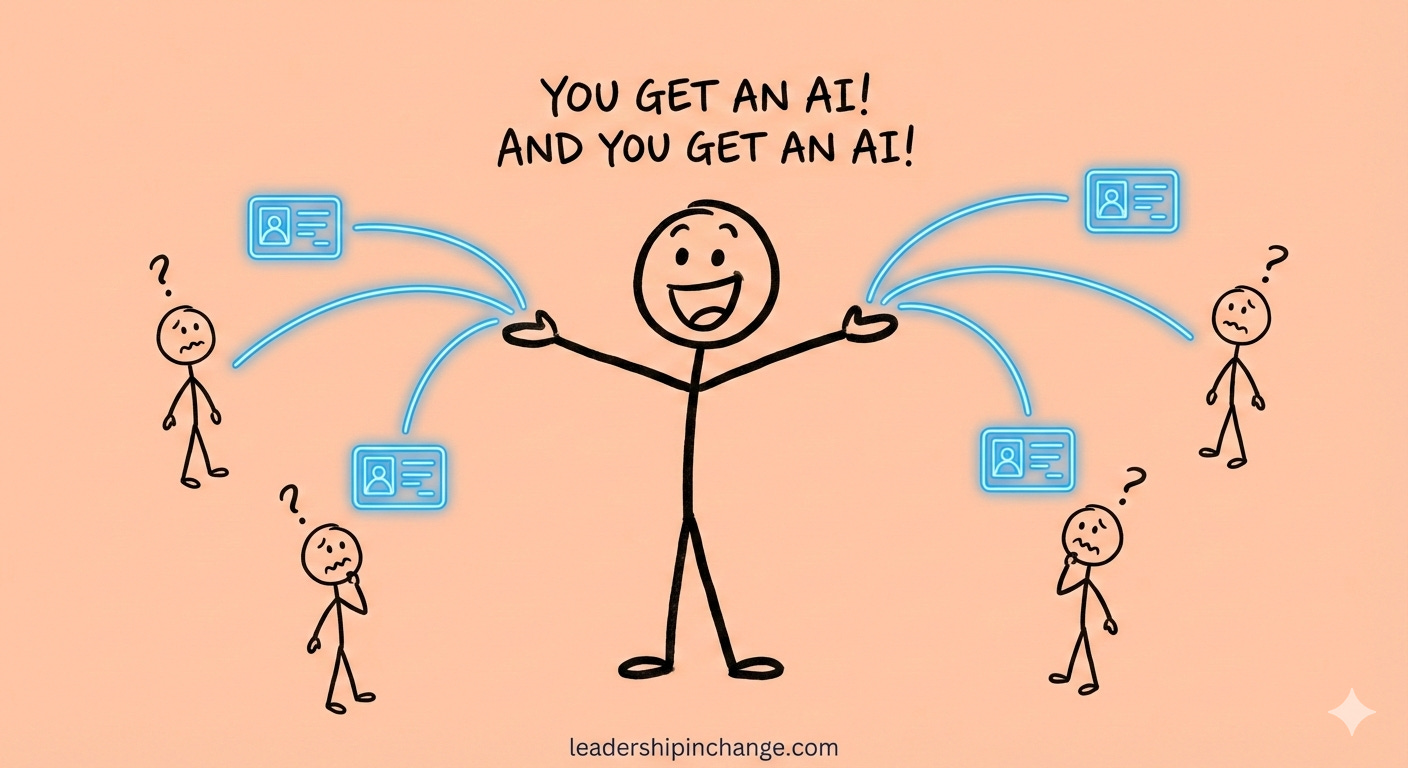
Here’s the mistake I see constantly… many leaders give everyone on the team ChatGPT access and call it an AI strategy.
In practice, it adds risk without anyone being responsible for the outcome.
82% of enterprise leaders now use AI at least weekly, but here’s the number that matters more: 72% of organisations now formally measure AI ROI (Wharton).
That shift happened because early adopters learned the expensive lesson that adoption without accountability creates chaos.
Leaders assume AI tools are like email or Slack. Give everyone access, and they’ll figure out how to use it responsibly.
But AI is different, it generates content that looks professional even when it’s factually wrong or tonally off-brand.
AI creates work that passes a quick glance but fails under scrutiny.
The questions that matter first
So how do you avoid this? Forget the tools for a minute.
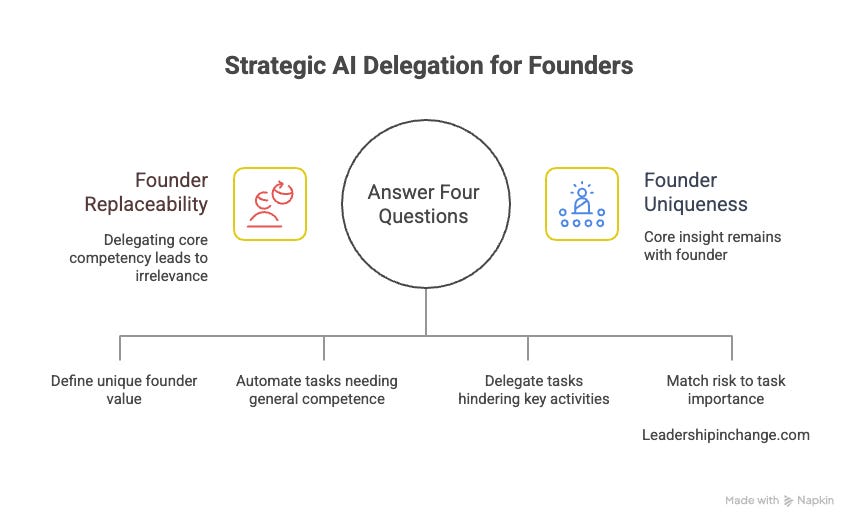
Answer these four questions first:
1️⃣ What decision or skill made you a founder in the first place?
Write this down, and I mean actually write it. Be specific. “I’m good at business” isn’t an answer. “I can spot inefficient processes in healthcare operations and redesign them” is an answer.
This is your protected zone. AI doesn’t touch this. You might use AI to support it, to research competitors, to analyse data, to draft documentation, but the core insight stays with you.
The reason this matters is simple: if you delegate your core competency, you become replaceable. I’ve seen founders automate themselves into irrelevance because they couldn’t articulate what made them uniquely valuable.
2️⃣ What work surrounds that core skill but doesn’t require your judgment?
Make a list of everything you did yesterday. Circle the tasks only you could do because of your unique insight or relationships. Everything else is a candidate for delegation.
For me, that’s first drafts. I’m good at translating complex AI concepts for mission-driven leaders. That’s the skill that built my publication. But I don’t need to personally type status updates or format spreadsheets. Those tasks don’t require my strategic judgment about what resonates with nonprofit directors or church leaders.
The key distinction is between tasks that require your specific expertise and tasks that require general competence.
AI can handle general competence. Your expertise is what people pay for.
3️⃣ What would you do with 10 extra hours per week?
Stop reading, and try to write down the answer.
This tells you what’s actually valuable. If your answer is “more sales calls,” delegate everything that isn’t sales. If it’s “more time thinking about product strategy,” delegate everything that isn’t strategic thinking.
I answer this question every quarter because the answer changes. Right now, my answer is “more time in actual conversations with leaders.”
That tells me I should delegate anything that keeps me behind a screen when I could be on a call, understanding what leaders actually struggle with.
4️⃣ What’s the cost of getting it wrong?
Some tasks have high costs if AI makes a mistake: client proposals, financial decisions, hiring, anything involving legal issues. These need human review even if AI creates the first version.
Some tasks carry very little downside, like formatting documents, organising files, or drafting social posts. These can be fully delegated because fixing an error takes less time than doing it yourself.
The real question is how much damage a mistake would actually cause.
A formatting error in an internal memo costs you nothing. A factual error in a client proposal costs you the client.
Where teams mess this up
Lastly, I want to go over some of the most common mistakes founders make when it comes to using AI.
Mistake 1️⃣ Delegating without context
“Write me a strategy document” produces garbage. “Write a 3-page strategy document for our Q2 product launch, focusing on enterprise healthcare customers, using data from our last survey” produces something useful.
The quality of AI output is directly proportional to the quality of your instructions. Vague inputs create vague outputs.
Mistake 2️⃣ No guardrails
I recently saw a nonprofit communications disaster, and it happened because they gave everyone ChatGPT without guidelines on voice, fact-checking, or approval processes. The fix is creating simple rules about what needs review and what doesn’t.
Mistake 3️⃣ Not measuring the tradeoff
Crowd Tamers reduced client costs from $8,000 monthly to $1,500 by automating video edits and social posts. They measured exactly where time went and what it cost. Most leaders guess. Successful ones track.
Mistake 4️⃣ Trying to automate everything at once
I spent three months trying to automate something I should not have. Complete disaster. I was spending more time fixing the output than writing from scratch. I wasn’t starting where I needed to start.
That’s it! You are ready to start, wisely and strategically.

Where this goes in 2026
Implementation is messier than it looks on paper. The framework is simple. Applying it to your specific workflow requires knowing what questions to ask.
If you want to walk through this framework for your specific situation, I’m offering 50% off implementation reviews to Millennial Masters readers, starting with a free 15 minute intro. We’ll create a map of your five highest-leverage AI opportunities and a plan to implement them. Most leaders find at least 10 hours per week. You can book an intro call here.

Start small. Measure everything. Protect what makes you different.


Really enjoyed putting this together. Thank you, Daniel!
One of my biggest career hacks. Mastering delegation then moving to "On The Business NOT In The Business" - this has enabled me to build multiple companies simultaneously and found multiple companies per year 🤫