



I ran a business for almost 15 years before I came across the idea of antifragility. By that point, it was too late.
I first heard it mentioned in one of my early Millennial Masters interviews with Yehong Zhu, who referenced Nassim Taleb’s Antifragile in her book recommendations.
By then, I had already lived through years where stability disappeared.
The pandemic period, especially 2020 through 2022, was one of the hardest stretches I’ve had in business and in life.
I had seen the shocks, the uncertainty, and plans breaking down without having a useful language for it, let alone a framework for how to respond.
That’s why John Brewton’s take stood out. When we spoke about antifragility and I read how he translated it into the day-to-day reality of running a company, I knew it would make a strong guest post for Millennial Masters.
His piece below turns antifragility into something far more useful than theory. It’s the practical version of what founders can do when the old playbook stops working. 👇🏻

How you build for shocks
It’s easy to get used to a stretch where demand is steady, costs are predictable, and suppliers pick up the phone.
That hasn’t been the world for a while now. Tariffs shift, energy prices move, and supplier pricing changes without much warning.
A Harvard survey of more than 4,000 SMBs found that nearly half of owners misjudged how tariffs were affecting their costs.
That’s not because small operators are careless. It’s because the world around them is changing faster than most people can track while still trying to run a business day to day.
Last October, I published a detailed piece on Operating translating Nassim Taleb’s ideas on antifragility into business practice. The framework still holds up, but frameworks do not pay invoices.
This is the practical version. It’s for the founder with 12 employees, one line of credit, and a Monday morning stand-up with very little patience for theory.
By antifragile, I mean a company that can take a shock and come out stronger on the other side. The goal is to build in a way that leaves you better placed when things move against you.
The 5 buffers that keep you in the game
Buffers are what keep a bad quarter from becoming a crisis.
If they are too thin, one shock can put you on the back foot. If they are strong enough, you have time to respond and, sometimes, enough room to take advantage.
1️⃣ Cash
How many weeks can you operate if revenue drops 30 percent tomorrow? Not based on a trailing twelve-month average, but on your actual weekly burn against your actual cash balance.
If the answer is less than eight weeks, that deserves your attention before almost anything else. When I was scaling R.G. Brewton from $27 million to north of $75 million in industrial distribution, the metric that gave us permission to be aggressive was knowing exactly how many weeks of runway we had.
2️⃣ Time
Slow decisions kill small companies faster than most bad decisions do. How many days does it take you to reprice a product, switch a supplier, or shut down a project that is bleeding money?
If the answer is weeks, you have a problem. Tariff policy changed eleven times in six months last year. The founders who got through it repriced in 48 hours. The ones who waited absorbed the margin hit.
3️⃣ Pipeline
If your top three clients represent more than 50% of revenue, your P&L can look steadier than it really is. It holds until one of them leaves, delays payment, or renegotiates terms.
Concentration risk is one of the most common buffer gaps I see in advisory work. It does not show up on a dashboard. It shows up on a Tuesday morning phone call.
4️⃣ Talent
Name every person in your company who is a single point of failure for a critical process. If that person gets sick, quits, or burns out, what breaks?
That is a structural weakness. Cross-train the role or document the process. Do that this month.
5️⃣ Suppliers
How many of your key inputs come from one source, one country, or one contract with no pre-vetted alternative?
In B2B distribution, we kept backup supplier relationships for every critical SKU category. Not because we assumed we would need them, but because if we did, there would be no time to start from scratch.
Small bets and fast feedback loops
Taleb’s barbell strategy is simple. Keep 80 to 90% of resources in proven work that pays the bills. Put 10 to 20% into small bets with real upside. The danger sits in the middle: the mid-budget initiative with medium conviction and no kill switch.
For a small company, a small bet is not something you talk about on a strategy retreat. It might be a landing page with $300 in ad spend behind a new offer, a pilot engagement with one client in a new vertical, or a price test on a single product line for two weeks.
What matters is that the hypothesis is written down before you spend the money, the downside is capped, and the timeline is short enough to read before the next move.
The kill rule matters more than the bet itself. Define what failure looks like before you start, not after sunk cost fallacy has you giving it another month. If a test cannot show signal within two to four weeks, it is either too slow or being measured badly.
Review active bets once a week. Spend fifteen minutes looking at what is still open, what should be killed, and what is showing enough signal to push harder.
Done properly, this is how small wins start to stack without small losses quietly piling up underneath them.
Guardrails to stop a bad month from spiralling
One bad month is manageable. The problem starts when a second bad month passes with no real response and a third is allowed to land on top of it. What matters most is how quickly you react.
This comes down to urgency, both yours and your team’s.
Three triggers should force a same-week decision:
Cash drops below your minimum weeks-of-coverage threshold
A top-three client signals churn or payment delay
The cost of a key input spikes by more than 15% with no clear date for it to come back down
When one of those triggers fires, do not leave it hanging. Make the call that week. The response might be small. Reprice one line, pause one project, or call one client. What matters is that you move.
Run a subtraction audit once per quarter. List every recurring cost, meeting, subscription, and initiative, then cut the bottom 10 to 15%. This is not about being tidy. It is about reducing the number of places where a shock can hurt you.
Every unnecessary cost gives rising prices another place to squeeze margin. Every unnecessary meeting takes time away from fixing what matters when something breaks.
Before any commitment above a number that matters to your business, spend ten minutes writing down how it could fail and whether the structure of the bet protects you if it does. It is Taleb’s premortem at founder scale.
It takes ten minutes. It has saved me from more bad decisions than any financial model.
5 items. 10 minutes. Weekly.
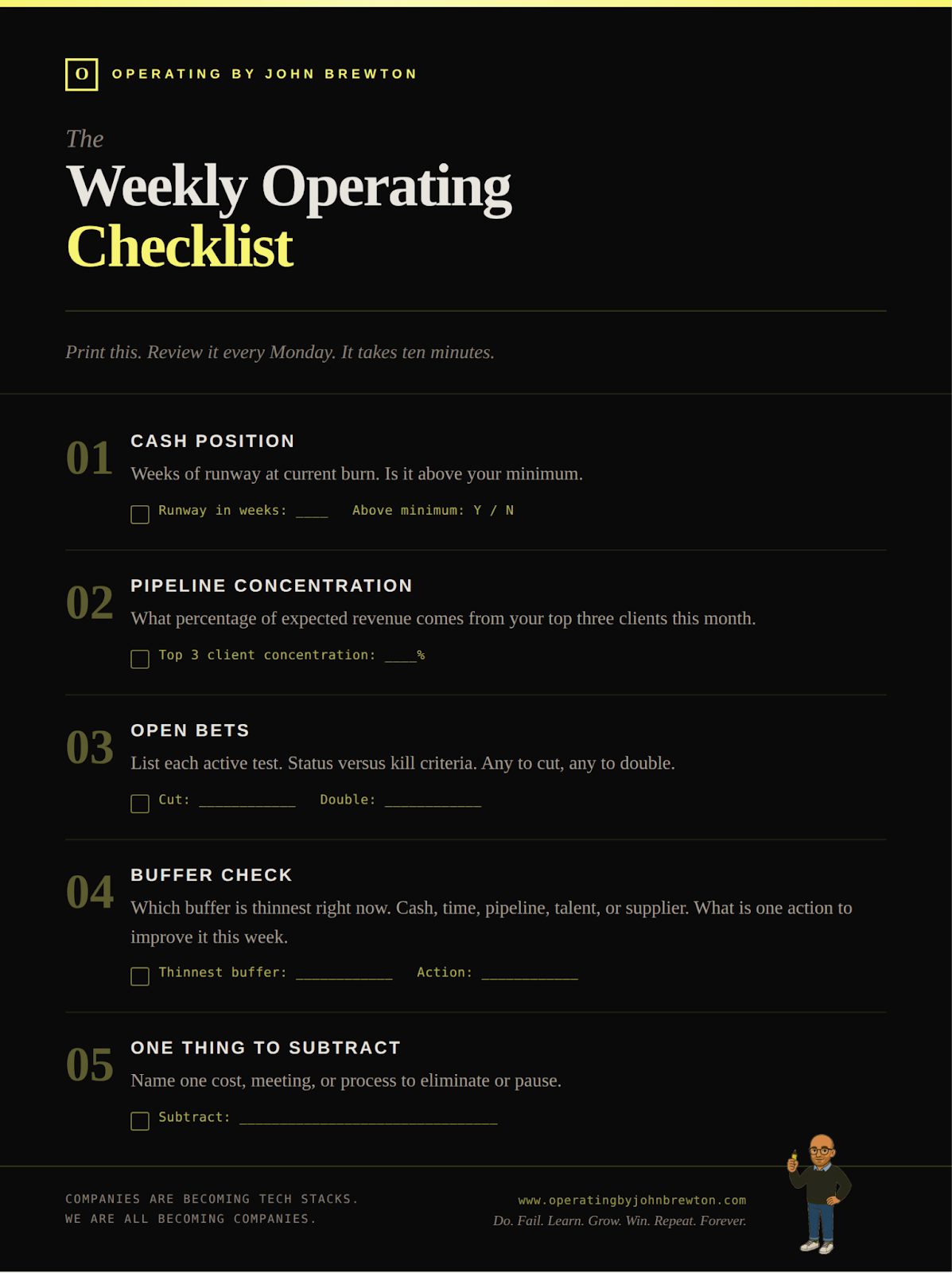
That’s the entire system. No single review will change much on its own. The value comes from doing it 52 weeks in a row.
The forecast is dead. Your business shouldn’t be.
You can’t run a company as if conditions will stay still long enough for the spreadsheet to catch up.
What matters more is whether the business can absorb pressure, respond quickly, and adjust when something changes.
This is practical, not theoretical. The founders who keep moving well under pressure are usually the ones who have already built for it.
👤 John Brewton writes Operating, a bestselling newsletter documenting the history and future of operating companies. He graduated Harvard University and began his career as a PhD student in economics at the University of Chicago. After selling his family’s B2B industrial distribution company in 2021, he spent the years since helping business owners, founders, and investors improve how they operate. He’s the founder of 6A East Partners, a research and advisory firm focused on the future of companies. He still cringes at his early LinkedIn posts and loves making content every day, despite protests from his wife, Fabiola. Connect with John on LinkedIn.


Looks great! Thrilled to have worked on this one together. Appreciate you my friend.
Great piece both of you! What’s the one practical thing John’s piece changed about how you’re actually running things day to day?