



AI can make a bad business decision sound perfectly sensible. Even when you ask it to pick holes in your plan, you can come away feeling you've done your homework.
That's how you end up mistaking a convincing answer for a proper check. When there's money on the line, that confidence can get expensive.
Adam Pryor runs Pryor Consulting, helping universities and non-profits use AI. He also writes Purposeful AI about putting the technology to work.
He's experienced that false reassurance himself. His guest piece gets into the questions that make AI give you something you can actually check. 👇🏻
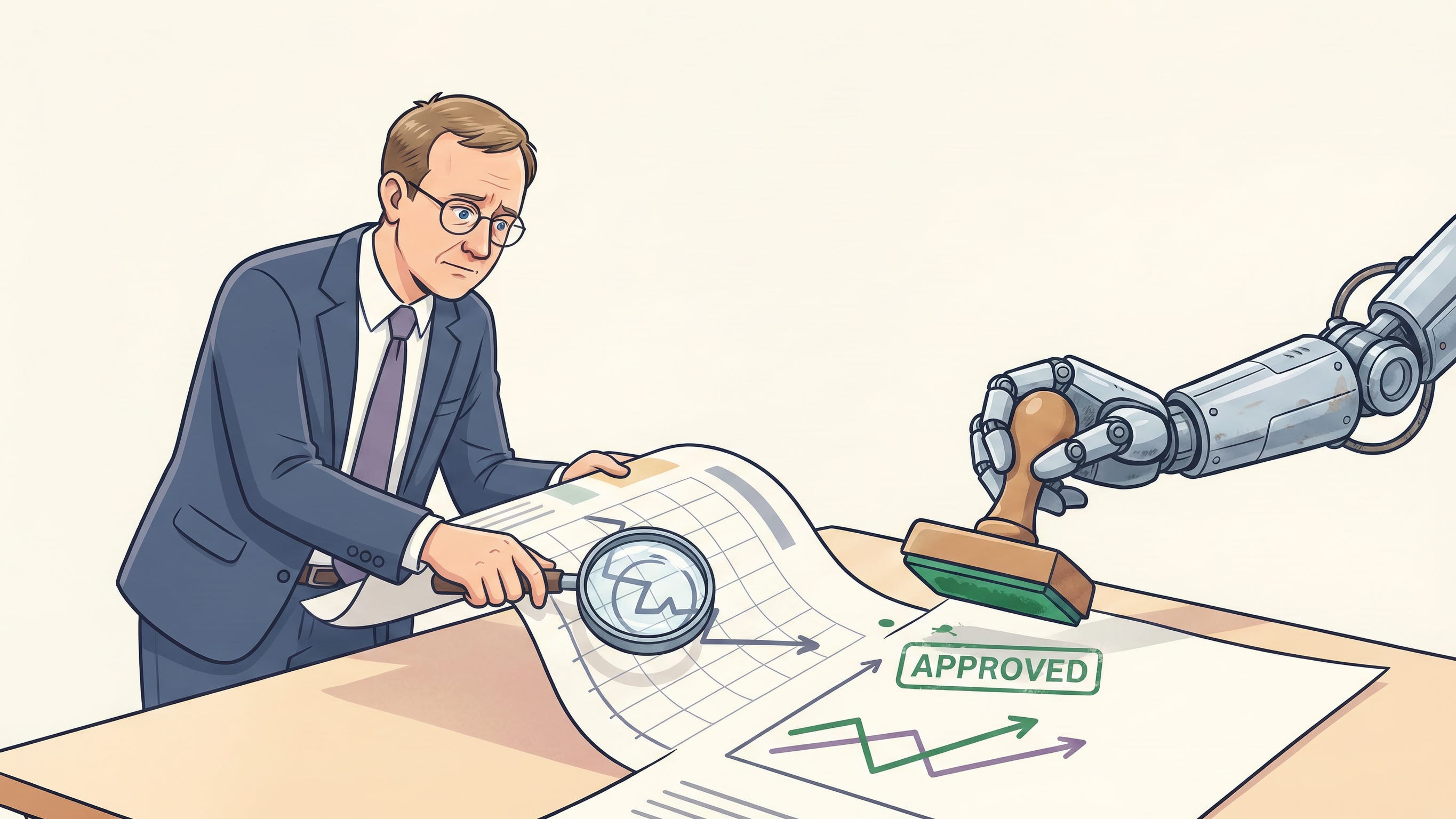
I spent forty minutes talking myself into a bad pricing model.
I had the tiers and the migration path mapped out. I put it into Claude and asked what was wrong. Back came a tidy list of considerations, two of which were really compliments. So I pushed: argue that this model is wrong. That answer had more bite, and I believed it more. It was just as useless because I still had no way of knowing whether any of it was true.
What finally worked was a worse-sounding question. I asked what number would have to hold for the model to work, and what I would expect to see in the first ninety days if it didn’t. Claude gave me a churn figure at the tier boundary. I looked that figure up in my own data. It was off by a factor of three, and by my calculation the model would have cost me a quarter of year-two revenue.
The first answer flattered me. The second answer entertained me1. Only the third one could have been wrong, and that is the only reason it was worth anything.
Make it say something that could be wrong
“This plan is strong” gives me nothing to check. There’s no observation I can make that would expose it as false. “The main risk here is execution” has the same problem. Asking the model to argue the other side sounds more responsible. Even a convincing objection isn’t much use if I can’t check it.
It used to take hours of work and somebody willing to stand behind what they’d written to produce a convincing argument. AI can now give me something that sounds just as considered in seconds. I still need to know whether it’s right.2
I get further when I make AI give me something I can prove wrong. Four questions help me do that:
“What would have to be true for this to work, and which of those do I actually know?” This shows me what I’m still assuming.
“Give me the number this depends on, and tell me where I would look it up.” A claim that names a source becomes a twenty-minute errand.
“What would I expect to see in ninety days if this is wrong?” Now the output has a date attached. Dates are the cheapest verification mechanism ever invented.
“Answer as JSON, not prose.” When a claim lands under a heading where it doesn’t belong, I’m more likely to notice it.
That last one is the one I’d defend hardest. JSON isn’t something I can easily skim and feel informed by. I have to work through the different parts and put the answer back together myself. The reassembly is the thinking.
Make the machine your devil's advocate
The person in your business who slows you down has taken a risk by disagreeing with you, and you can ask them how they know. That’s what makes their objection useful.
A careful human checking every AI answer before it ships sounds sensible. I worry about the check sitting outside the work. When speed becomes the priority, that separate step is easy to sacrifice.
Put the devil’s advocate inside the machine instead.3 Demand a specific objection and a number you can check. If I keep challenging the machine to find a testable objection, it begins to do the same to my plan. The machine still wants to please me.4 I’m teaching it that a useful answer is one I can put to the test.
That doesn’t make my own checking disappear on day one. Claude gave me a churn figure; my own data showed it was wrong. As I learn which tasks AI handles reliably, I can deliberately check its work less often. That still takes judgement. That’s what I mean by a verification engine.
It won’t stay in that role automatically. Four exchanges after I’ve set the rule, the AI can be admiring my framing again. No saved prompt replaces the habit of asking for an answer that could fail.
If I keep pushing AI to challenge my thinking, it won’t get tired of finding problems. It won’t stop at the fourth objection because a meeting is running long. It will produce the ninetieth thing that would have to be true while you make coffee.
So take the decision that would hurt most to get wrong and quit asking the machine for its opinion. Make it tell you what would have to be true and where you’d look for evidence. Then go and look.
👤 Adam Pryor founded Pryor Consulting to help universities and non-profit organisations make practical use of AI. He has more than 12 years' experience in higher education and writes Purposeful AI about using the technology while keeping human judgement involved. Connect with Adam on LinkedIn.



In a study of 11 AI models, Myra Cheng and Dan Jurafsky's team found that AI affirmed users' actions 49% more often than humans did. In experiments with 2,405 participants, sycophantic replies left people more convinced they were right, while they also trusted the agreeable AI more. The very thing degrading your judgement simultaneously registers as the better tool. These experiments involved interpersonal disputes, not business pricing.
Anne-Sophie Mayer and colleagues followed loan consultants at a German bank who had to defend AI credit decisions they couldn't interrogate. Some supplied reasons from their own experience rather than admitting they couldn't account for the outcome. The researchers called it masking. This concerned an AI-assisted credit system, rather than a chatbot.
For centuries, candidates for sainthood faced a promotor fidei, commonly known as the devil's advocate. The 1911 Catholic Encyclopedia says his job included suggesting natural explanations for alleged miracles, and that his doubts had to be satisfactorily answered before a case could advance. The devil's advocate was a verification procedure wearing a person.
Mrinank Sharma and his co-authors tested five AI assistants and found the same behaviour in all of them. When they examined the human preference data underneath, matching the user's stated belief was among the strongest predictors of whether a person rated an answer highly.